

A Dual Torch Pipeline Welding Machine can turn repetitive field welding into a faster, more consistent operation. It can also expose weak planning quickly. Torch spacing, wire delivery, shielding gas, travel speed, and heat input must work together. One overlooked setting may create porosity, undercut, or excessive distortion.
Industry demand supports closer evaluation. Grand View Research estimates that the global welding equipment market will expand steadily through 2030, driven by construction, energy, and infrastructure investment. Fortune Business Insights also reports continued growth in automated welding equipment, especially where manufacturers need higher productivity and repeatable quality. These reports show market momentum, but they do not prove that every dual-torch system suits pipeline work. Specifications still matter more than impressive brochures.
John C. Lippold, a respected welding-metallurgy researcher, offers a useful principle: “Weldability is a process issue, not merely a material issue.” That idea applies directly here. Buyers should examine procedure qualification support, pipe diameter range, wall-thickness capability, welding position, cooling design, and control-system accuracy. Ask for documented production results. Watch a live weld if possible. Look closely at the bead profile, arc stability, and operator access.
The best machine is not always the fastest one. Sometimes, reliability wins.
This guide compares torch configuration, automation level, power-source compatibility, maintenance needs, safety controls, and total ownership cost. It also considers an uncomfortable question: can the machine maintain quality when site conditions become dusty, cold, crowded, or unpredictable? A careful answer may prevent an expensive purchase.
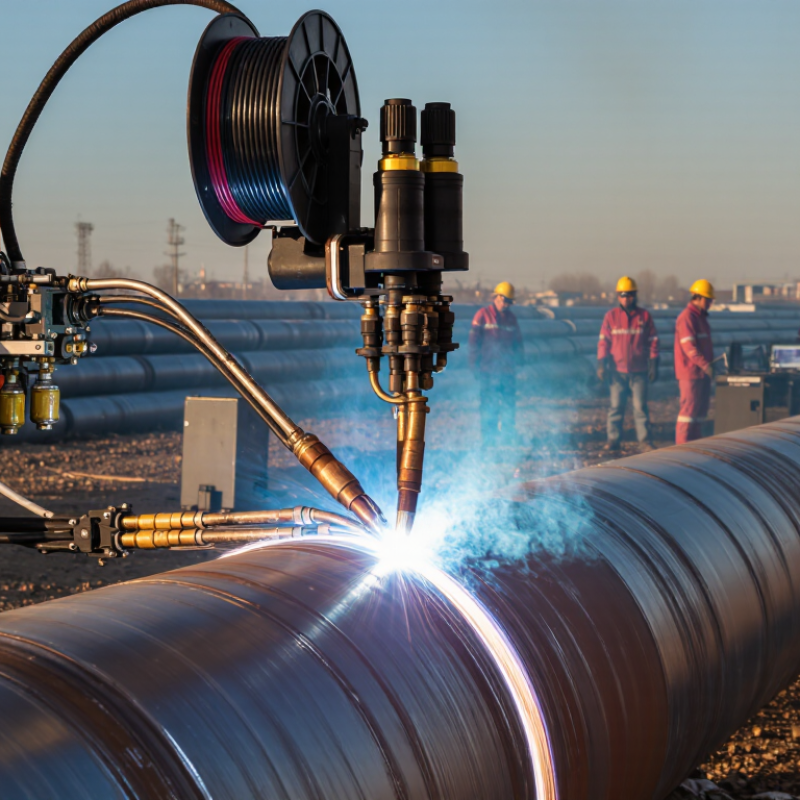
A dual torch pipeline welding machine is a mechanized system that uses two welding torches on one carriage or welding frame. The torches operate together around a pipe joint. Each torch covers a separate section of the weld groove. This arrangement can increase production speed while maintaining more consistent heat distribution.
In field applications, operators commonly use dual torches for long pipeline projects, especially when repeated circumferential welds demand stable performance. One torch may lead while the second follows at a controlled angle and distance. Depending on the machine design, both torches can share travel speed, wire feeding, shielding gas, or power settings. Accurate alignment matters. A small spacing error can create uneven penetration, overlapping beads, or excessive heat.
A reliable machine should offer adjustable torch spacing, steady carriage movement, clear control panels, and compatible welding processes. Buyers should also check pipe diameter ranges, duty cycle, cooling methods, and access to replacement parts. Training remains essential, even with automated movement. The machine does not correct a poorly prepared joint. It also cannot fully compensate for wind, contamination, or incorrect welding parameters.
Dual torch systems are efficient, but they are not automatically better for every site. Narrow work areas may limit access. Two arcs can complicate monitoring. I would test the machine on representative pipe sections before purchase, because catalog specifications rarely show every field difficulty. Small details matter.
A dual torch pipeline welding machine uses two coordinated arcs on one joint. The torches may share a travel carriage, but their jobs are different. The leading torch establishes penetration and heats the bevel. The trailing torch adds filler metal and shapes the weld profile. This arrangement can reduce pass time when joint design and material allow it. It is not simply twice the speed.
Control software synchronizes travel speed, wire feed, current, voltage, and torch spacing. Shielding gas must cover both arcs without disturbing the molten pool. Operators watch arc length, bead width, and interpass temperature at the joint. Seam tracking helps each torch follow the pipe centerline, especially near small alignment changes. A slight spacing error can create overlap, undercut, or incomplete fusion. Those defects are not always visible immediately.
Reliable use begins with a qualified welding procedure and verified calibration. Technicians inspect contact tips, liners, grounding, and gas flow before production. They also record heat input and environmental conditions. In windy field locations, gas protection becomes harder, so expected productivity may disappear. Experienced crews adjust parameters gradually, then examine samples through visual checks and approved nondestructive testing. One weak assumption remains: dual torch equipment cannot compensate for poor fit-up. Even a stable machine needs human judgment, and procedures sometimes require revision after real pipe trials.
2026 Top Dual Torch Pipeline Welding Machine Buying Guide
When comparing a dual torch pipeline welding machine, start with output stability, not maximum amperage. A high rating looks impressive, but it may offer little value during long field welds. Check the rated duty cycle at the amperage your crew actually uses. Sixty percent at 300 amps is more useful than a vague peak figure.
Review input power carefully. Confirm whether the machine supports single-phase or three-phase supply, and check its voltage tolerance. Unstable power can create uneven arcs and repeated stoppages. Wire-feed speed, compatible wire diameters, and independent torch controls also deserve close attention. Independent adjustment helps two operators maintain different welding settings without fighting over one control panel.
Torch cooling is another practical specification. Air cooling may suit lighter work, while liquid cooling can reduce heat stress during continuous operation. Examine hose length, cable flexibility, and connector strength. Small details matter on muddy ground. They often do.
Ask for measured noise, weight, and enclosure protection rather than relying on sales language. A machine that is difficult to move may remain unused. Safety functions, overload protection, grounding design, and documented test results should be clearly available. I would also request a live demonstration with the intended wire and pipe thickness. Specifications can be accurate yet incomplete. That is where my own earlier comparisons sometimes went wrong.
2026 Top Dual Torch Pipeline Welding Machine Buying Guide
Choosing a dual torch pipeline welding machine starts with the project, not the product brochure. Measure pipe diameter, wall thickness, joint design, material grade, and expected daily welds. Dual torches can shorten cycle time, but only when both arcs remain stable. Poor synchronization may create uneven penetration and costly repairs.
Look for independent current control, precise wire feeding, adjustable travel speed, and a duty cycle suited to continuous field work. A rugged enclosure matters in dust, wind, and temperature changes. Remote controls can reduce movement around the joint. Field experience suggests checking cable length carefully; short leads become frustrating beside large-diameter pipe.
Industry data supports careful operator planning. The Manufacturing Institute and Deloitte reported that U.S. manufacturing could face 1.9 million unfilled jobs by 2033. Training simplicity therefore matters. The U.S. Bureau of Labor Statistics recorded about 453,000 welding-related jobs in 2024, showing the value of efficient equipment. Confirm that the machine supports qualified procedures under API 1104 or applicable ASME requirements. Ask for weld logs, calibration records, service response times, and realistic output tests. Marketing numbers can look impressive. They are not always field numbers. A machine that welds slightly slower, but produces fewer repairs, may deliver better project economics.
Use this comparison as a practical specification guide when evaluating dual-torch pipeline welding machines. Actual capacity depends on the welding process, joint design, material grade, shielding conditions, power source, and applicable project specifications.
| Pipeline Project Type | Typical Pipe Outside Diameter | Typical Wall Thickness | Recommended Welding Processes | Typical Welding Current Range | Dual-Torch Configuration | Recommended Power and Duty Cycle | Key Buying Priority |
|---|---|---|---|---|---|---|---|
| Small-diameter utility and process lines | 60–168 mm (2–6.6 in) | 3–12 mm (0.12–0.47 in) | GTAW for root passes; SMAW or GMAW for fill and cap passes | 60–250 A for GTAW 90–350 A for SMAW/GMAW | Two synchronized torches for root and fill work, or two operators working on opposite sides of the joint | Single- or three-phase inverter; 60% minimum duty cycle at the intended output | Compact carriage, precise low-current control, and easy access around small pipe |
| Medium-diameter transmission and gathering lines | 168–406 mm (6.6–16 in) | 6–20 mm (0.24–0.79 in) | GTAW, GMAW, FCAW, or mechanized narrow-gap welding | 100–400 A per torch | Independent travel and wire-feed controls with adjustable torch spacing and synchronized oscillation | Three-phase power source, typically 400–600 A total system capacity, with 60–100% duty cycle | Stable travel speed, arc synchronization, and repeatable parameter storage |
| Large-diameter cross-country pipeline | 406–1,220 mm (16–48 in) | 8–25 mm (0.31–0.98 in) | Mechanized GMAW or FCAW; GTAW may be used for critical root passes | 150–450 A per torch | Two torches positioned on the same weld station or on opposite sides of the pipe, with coordinated travel control | Three-phase generator or plant power; 600–1,000 A combined capacity is commonly suitable for two-arc operation | High deposition rate, automatic seam tracking, and dependable cooling |
| Heavy-wall pipeline and high-strength steel | 610–1,420 mm (24–56 in) | 20–40 mm (0.79–1.57 in) | FCAW, GMAW, or qualified multi-pass mechanized welding procedures | 200–500 A per torch | Independent arc control, separate wire feeders, synchronized oscillation, and programmable pass sequences | Industrial three-phase system; 800–1,200 A combined capacity may be required depending on wire size and procedure | Thermal management, arc stability, procedure repeatability, and accurate heat-input control |
| Stainless steel and corrosion-resistant alloy pipe | 60–610 mm (2–24 in) | 2–20 mm (0.08–0.79 in) | GTAW with argon shielding; GMAW or FCAW for larger fill sections when qualified | 40–300 A per torch | Two GTAW torches or a GTAW root torch paired with a mechanized fill torch | High-frequency start, programmable pulse control, and 60% or higher duty cycle | Low-spatter operation, shielding-gas control, and accurate current pulsing |
| Field construction and remote locations | 168–1,220 mm (6.6–48 in) | 6–25 mm (0.24–0.98 in) | SMAW, FCAW, GMAW, or portable mechanized welding systems | 100–400 A per torch | Removable dual-torch carriage with quick-change torch mounts and independent controls | Engine-driven generator or rugged three-phase supply; select a system rated for the expected ambient temperature | Low weight, sealed controls, simple maintenance, and strong ground clearance |
| Workshop prefabrication and production spools | 60–1,420 mm (2–56 in) | 3–40 mm (0.12–1.57 in) | GMAW, FCAW, GTAW, or submerged arc welding where suitable | 100–600 A per torch | Fixed or rail-mounted dual torches with automated travel, oscillation, and pass sequencing | Stable three-phase supply with 100% duty cycle preferred for continuous production | Automation capability, production speed, data logging, and repeatable weld quality |
| Repair, tie-in, and shutdown work | 168–1,220 mm (6.6–48 in) | 6–25 mm (0.24–0.98 in) | Process selected according to the approved welding procedure and in-service restrictions | 80–350 A per torch | Independent torch enable/disable functions and fast adjustment of torch angle and spacing | Portable power source with overload protection and at least 60% duty cycle | Fast setup, precise control, access to restricted areas, and easy parameter changes |
| Selection Dimension | Recommended Specification | Why It Matters for Pipeline Work |
|---|---|---|
| Torch control | Independent current, voltage, wire-feed, travel, and torch-enable controls | Different weld passes and pipe positions often require different parameters. Independent control prevents one torch from limiting the other. |
| Travel speed | Smooth adjustable travel, commonly from approximately 50–1,500 mm/min depending on process | Stable travel speed helps maintain bead profile, penetration, heat input, and interpass consistency. |
| Wire diameter compatibility | At least 0.8–1.6 mm for GMAW/FCAW; confirm compatibility with the qualified procedure | Wire diameter affects deposition rate, current range, penetration, and the suitability of the machine for root, fill, and cap passes. |
| Power supply | Match input voltage, phase, frequency, generator capacity, and total current demand | Two torches can substantially increase power demand. The supply must support simultaneous arcs without voltage instability. |
| Duty cycle | 60% minimum for intermittent field work; 100% preferred for continuous workshop production | Duty cycle indicates how long the system can weld within a standard test period before cooling is required. Always compare ratings at the intended amperage and ambient temperature. |
| Pipe tracking and fit-up | Adjustable guide rollers, strong magnetic or mechanical traction, and optional seam tracking | Pipe ovality, misalignment, and changing joint conditions can cause torch displacement and inconsistent arc length. |
| Cooling system | Air cooling for lower-current applications; liquid cooling for sustained high-current dual-arc operation | Effective cooling reduces torch wear, overheating interruptions, and premature failure during long welding cycles. |
| Safety and compliance | Overcurrent protection, emergency stop, thermal protection, proper grounding, and documented operating procedures | Pipeline welding involves high current, hot metal, shielding gases, and difficult field conditions. Safety functions should be verified before purchase and commissioning. |
Important: The ranges shown are typical engineering selection ranges rather than guaranteed machine ratings. Confirm the final choice against the approved welding procedure specification, applicable pipeline code, base-metal grade, joint preparation, electrode or wire classification, environmental conditions, and the manufacturer’s certified duty-cycle data.
A dual torch pipeline welding machine demands disciplined preparation, not just high output. Before operation, inspect hoses, regulators, torch bodies, and connections for cuts, dents, or loose fittings. Keep cylinders upright and secured. Store oxygen away from fuel gas, heat, and oily materials. Never use oil on oxygen equipment. Test connections with an approved leak-detection solution before lighting the torches. Good ventilation matters, especially in trenches or enclosed work areas. Wear a properly shaded helmet, flame-resistant clothing, gloves, safety boots, and hearing protection.
Maintenance should follow a written schedule. Clean torch tips carefully, remove spatter, and check flame stability during every shift. Replace damaged hoses immediately. Do not keep using a torch because production is behind. That decision can become expensive. Inspect flashback protection devices and regulators according to the manufacturer’s instructions. Record defects, repairs, gas settings, and operating hours. These notes help identify repeated failures, although rushed records are often incomplete.
Tips:
Confirm both torches have balanced flames before welding. Keep hoses behind the operator’s feet and away from hot metal. Adjust travel speed when wall thickness changes. Watch for distortion, uneven heating, or unusual popping sounds. Shut down the system in the correct sequence after work, then close cylinder valves and release line pressure. I have seen experienced operators skip this final check. It takes minutes, but it prevents avoidable damage. Practice with a qualified supervisor when changing fuels, torch angles, or joint designs. Never rely on memory alone.
TERMS OF USE - LEDOLUX
This site uses cookies in order to deliver services in accordance with Privacy Policy. You can use settings within your browser to control the cookies that are set on your computer – conditions of access or storage of cookies.
Your data controller will be LEDOLUX POLAND SP. ul. Innowacyjna 1; 36-060 Głogów Małopolski, which adapts the content of its website to your needs and analyses and examines them to improve it. More information.