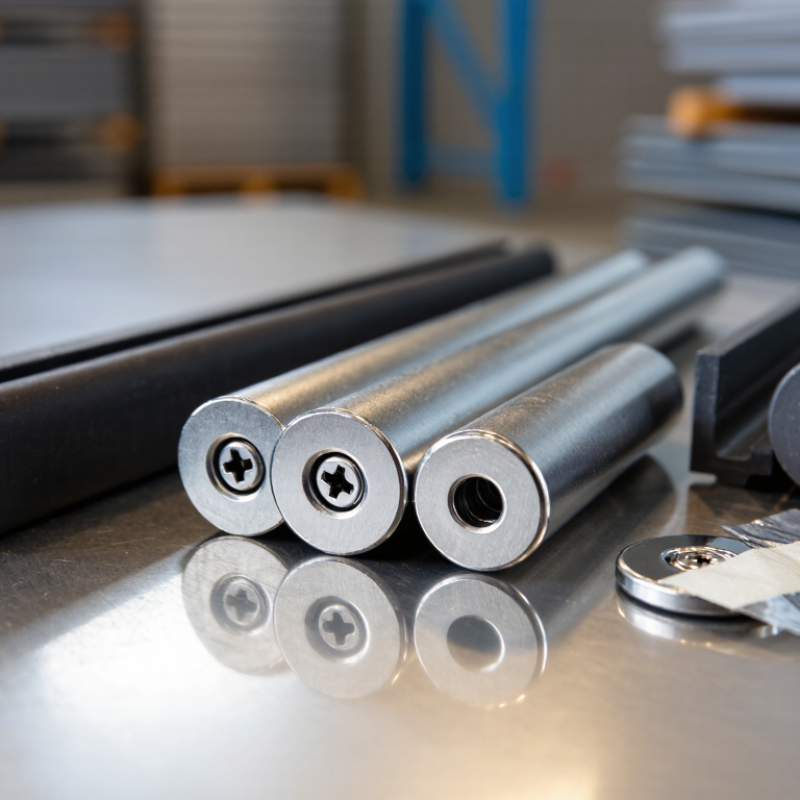
Neodymium Channel Magnet
Steel channel containing a neodymium-iron-boron magnet | High-energy permanent magnet protected by a mild-steel or carbon-steel channel. The channel concentrates the magnetic field toward the working face and protects the magnet from impact. | Fixtures, cabinet and door closures, retail displays, signage, sensors, light industrial holding, and compact mounting systems. | Very high magnetic strength for its size; compact design; suitable where installation space is limited; available with countersunk holes, threaded holes, adhesive backing, or mounting slots. | More sensitive to corrosion than ferrite; magnetic performance can decline if exposed to excessive heat; brittle magnet material can chip if not properly enclosed. | Many standard grades are designed for continuous use around 80 °C. High-temperature grades may support approximately 120–200 °C, depending on the magnet grade, coating, adhesive, and steel assembly. | Confirm magnet grade, remanence, coercivity, dimensional tolerance, coating thickness, pull-force test method, and temperature rating. Request salt-spray or humidity data when the product will be used in damp environments. | Request a complete material specification and safety data where applicable. Confirm whether the finished assembly is classified as a permanent magnet for transport and whether packaging meets the carrier’s air-freight magnetic-field limits. |
Ferrite Channel Magnet
Ceramic ferrite magnet mounted in a steel channel | Hard ferrite, usually based on strontium ferrite, enclosed or backed by a steel channel to improve mechanical protection and magnetic flux direction. | Magnetic catches, educational products, low-cost fixtures, advertising displays, furniture hardware, and general-purpose holding applications. | Low material cost; good resistance to corrosion; stable supply; generally better heat tolerance than standard neodymium magnets; suitable for high-volume products. | Lower magnetic energy than neodymium; larger dimensions may be required for equivalent holding force; ceramic material is relatively brittle. | Many ferrite formulations can operate at approximately 150–250 °C, but the complete channel assembly may have a lower limit because of adhesives, coatings, and non-magnetic fittings. | Verify ferrite grade, dimensions, polarity, surface condition, chipping limits, pull force on the specified steel target, and performance after thermal cycling. | Often simpler to ship than high-strength rare-earth assemblies, but the final product should still be checked against carrier rules. Confirm country-of-origin marking, carton quantity, and moisture protection for sea freight. |
Rubber-Coated Channel Magnet
Permanent magnet assembly with a molded rubber or elastomer protective layer | Usually uses neodymium or ferrite inside a steel channel, covered with rubber, thermoplastic elastomer, or another non-slip protective material. | Vehicle-mounted signs, temporary fixtures, outdoor displays, equipment positioning, marine-related applications, and painted or delicate metal surfaces. | Reduces scratching; improves grip on smooth surfaces; provides vibration damping; can improve resistance to splash water and handling damage. | Rubber hardness, UV stability, oil resistance, and temperature limits vary widely. Rubber can wear, tear, swell, or lose grip over time. | Common elastomer systems may be suitable for approximately −30 to 80 °C, but the actual range depends on the compound, magnet grade, adhesive, and exposure conditions. | Verify rubber hardness, tensile and tear properties, UV and chemical resistance, adhesion between layers, waterproofing method, pull force through the coating, and aging performance. | Ask for the elastomer material declaration and restricted-substance compliance documentation. Use moisture-resistant packaging and confirm that the coating does not prevent customs inspection or required product marking. |
Countersunk Channel Magnet
Recessed mounting-hole channel magnet | A permanent magnet in a steel channel with one or more countersunk holes for flat-head screws. Neodymium is common when high holding force is required. | Removable panels, access doors, tools, fixtures, display systems, machine guards, and modular assemblies. | Flush installation; positive mechanical fastening; easy replacement; less dependence on adhesive; suitable for repeated installation and removal. | Incorrect screw length or excessive tightening can damage the magnet or reduce the effective magnetic circuit. Screw heads and mounting surfaces must match the hole geometry. | The magnetic element may tolerate a specified temperature, but the practical limit can be set by the screw coating, substrate, adhesive, or surrounding component. | Check hole diameter and angle, screw compatibility, hole-to-magnet clearance, polarity, pull force after fastening, torque limit, and dimensional tolerance of the mounting face. | Confirm whether screws are included and identify their material and finish. If supplied separately, verify the correct tariff treatment and packaging count for fasteners and magnetic assemblies. |
Adhesive-Backed Channel Magnet
Channel magnet with pressure-sensitive adhesive mounting layer | A ferrite or neodymium channel assembly fitted with a single-sided adhesive tape or adhesive pad, often with a removable liner. | Lightweight signs, point-of-sale displays, cable management, office fixtures, temporary mounting, and non-permanent closures. | Fast installation; no drilling; clean appearance; useful for thin or inaccessible substrates; can reduce assembly labor. | Adhesive strength depends on surface cleanliness, contact area, pressure, dwell time, temperature, load direction, and long-term aging. It may not be suitable for overhead or safety-critical loads. | The magnet and the adhesive have separate temperature limits. Many pressure-sensitive adhesive systems require application above approximately 10 °C and have service limits commonly around 80–120 °C, subject to the adhesive specification. | Request peel and shear data, surface-preparation instructions, liner type, application pressure, dwell-time requirements, aging results, and a load test on the buyer’s actual substrate. | Confirm adhesive composition and restricted-substance declarations. Protect liners from heat, dust, humidity, and compression during international transport. Include installation instructions in the destination language when required. |
High-Temperature Channel Magnet
Heat-resistant permanent magnet assembly | May use high-temperature neodymium, samarium-cobalt, or high-temperature ferrite, combined with a steel channel and heat-resistant coating or fastening system. | Industrial fixtures, ovens and thermal equipment, exhaust-adjacent installations, high-temperature sensors, tooling, and process equipment. | Retains useful magnetic performance at temperatures above the normal limit of standard neodymium magnets; can reduce the need for mechanical clamps in selected applications. | Higher cost; lower magnetic energy or greater size may be required; the channel, coating, adhesive, and substrate may fail before the magnet itself. | Samarium-cobalt can support very high temperatures, with some grades rated approximately 250–350 °C. Actual continuous-use limits must be confirmed for the complete assembly, not only the magnet material. | Require temperature coefficients, maximum operating temperature, thermal-cycling results, irreversible-loss data, coating compatibility, and a hot-condition pull-force test. | Provide the supplier with the full temperature profile, duty cycle, atmosphere, and installation materials. Confirm export packaging, product labeling, and transport classification before placing an international order. |
Multi-Pole Channel Magnet
Channel magnet with alternating magnetic poles along the working face | A permanent magnet assembly engineered with multiple north and south poles to create a concentrated near-surface magnetic pattern. | Thin-sheet holding, magnetic separators, encoder and sensor systems, flexible closures, linear positioning, and applications requiring controlled surface flux. | Strong near-surface attraction; improved positioning behavior in some designs; can provide a more controlled magnetic field than a simple single-pole assembly. | Working distance is usually limited; performance is highly dependent on pole pitch, air gap, target thickness, and target material; not interchangeable with a standard single-pole channel magnet. | Temperature capability depends on the selected magnet material and the complete assembly. Standard neodymium versions commonly require protection from temperatures above approximately 80 °C. | Verify pole pitch, pole sequence, magnetic field map, polarity orientation, air-gap performance, target-material assumptions, and repeatability between production batches. | Provide clear polarity drawings and protective packaging. Magnetic-field measurements may be needed for air transport, especially when several assemblies are packed together or shipped in bulk. |
Stainless-Steel Channel Magnet
Magnet assembly using stainless-steel housing or exposed stainless hardware | A ferrite, neodymium, or other permanent magnet enclosed in stainless steel or fitted with stainless mounting hardware for improved environmental resistance. | Food-service equipment, washdown areas, laboratory fixtures, outdoor hardware, marine environments, and applications requiring a cleanable surface. | Improved resistance to staining and corrosion compared with untreated carbon steel; clean appearance; suitable for frequent cleaning when the design is properly sealed. | Stainless steel is not automatically non-magnetic or corrosion-proof. Some stainless grades are magnetic, while others can reduce magnetic performance or provide limited mechanical strength. | Temperature depends on the magnet grade, stainless-steel grade, seal, and joining method. Verify the complete assembly rating rather than relying on the steel designation alone. | Confirm stainless-steel grade, magnetic permeability, weld or crimp quality, sealing method, corrosion test results, surface roughness where relevant, and compatibility with cleaning chemicals. | Request material certificates and corrosion documentation. Confirm any food-contact or sanitary requirement separately; a stainless-steel housing alone does not establish regulatory compliance. |
Custom Profile Channel Magnet
Application-specific shape, length, hole pattern, polarity, or overmold | Engineered assembly combining a selected permanent magnet material with a custom steel channel, machined features, adhesive, rubber, plastic, or protective coating. | Automated equipment, custom enclosures, medical and laboratory devices, specialized fixtures, energy equipment, and OEM replacement parts. | Optimized fit and magnetic performance; can integrate mounting and protection features; suitable for repeat-production programs with stable drawings and inspection standards. | Longer development time; tooling and engineering charges may apply; design changes can affect magnetic performance, cost, lead time, and import documentation. | Must be established from the complete design. The lowest-rated component—magnet, adhesive, polymer, coating, or fastener—usually determines the practical operating limit. | Approve a controlled drawing, first-article sample, dimensional inspection report, magnetic-field or pull-force report, material certificates, coating results, and change-control procedure. | Define Incoterms, inspection responsibility, packaging, carton marks, origin information, documentation language, and acceptance criteria before production. Obtain a pre-production sample before committing to volume. |