

What Is the Best Hairpin Tube Bender in 2026?
Choosing the best Hairpin Tube Bender in 2026 is not simply a brand contest. It is a process decision shaped by tube dimensions, bend quality, production volume, and operator experience. The International Energy Agency’s 2018 report, The Future of Cooling, projected that the global stock of air conditioners could grow from 1.6 billion units to 5.6 billion by 2050. That forecast points to expanding cooling-equipment demand—and continued pressure on manufacturers to produce reliable heat-exchanger components efficiently.
A hairpin bend may look simple on a finished coil. In production, small variations in bend radius, springback, or tube alignment can affect fit and assembly. A useful machine comparison therefore looks beyond advertised speed. Consider repeatability, supported tube materials and sizes, tooling-change time, controls, and service access. Ask suppliers for sample bends using your actual tube and wall thickness. Then inspect the results, not just the demonstration screen.
No single machine suits every line. A high-output model may be excessive for short runs, while a basic bender may struggle with frequent changeovers. The IEA report describes cooling-market growth; it does not rank bending machines or predict specific tooling demand. That distinction matters. This guide compares practical selection criteria and machine types, helping buyers identify a Hairpin Tube Bender that fits their real production needs—not an idealized factory floor.
What a Hairpin Tube Bender Does and Where It Is Used
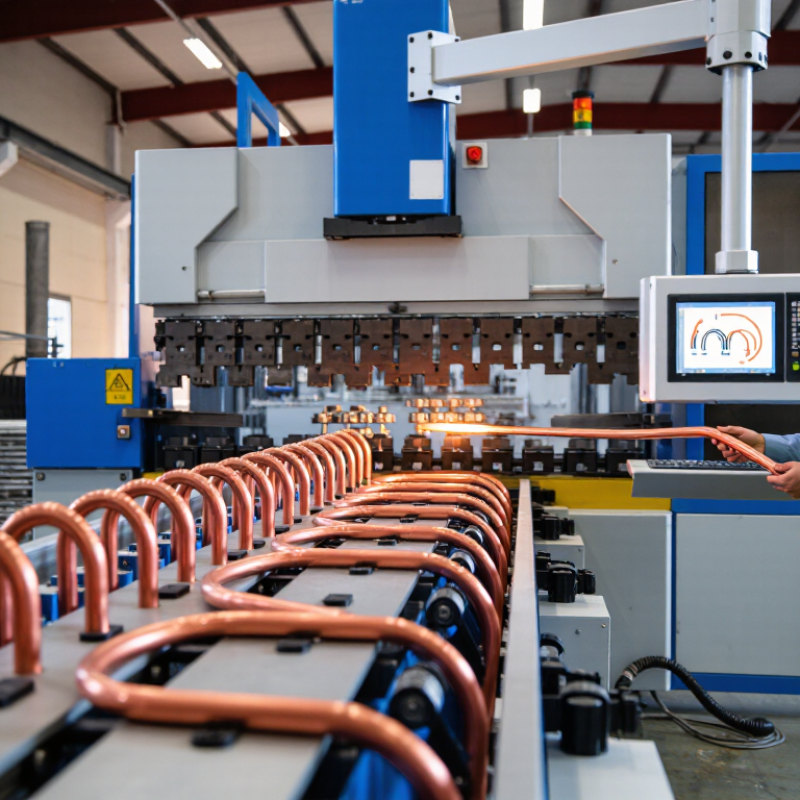
A hairpin tube bender turns straight tubing into repeatable U-shaped returns, often called hairpins, for heat-exchanger coils. These bends connect parallel tube passes in air-conditioning and refrigeration evaporators and condensers. On a production floor, the operator feeds a measured tube length into the machine, selects a bend radius, and checks that the curve stays smooth. A flattened section or kink can restrict flow and make assembly harder.
The International Energy Agency’s 2018 report, The Future of Cooling, projected that global air-conditioner stock could grow from 1.6 billion units to 5.6 billion by 2050. That projection does not measure bender demand directly. It does show why consistent coil production matters. Hairpin benders help manufacturers form many matching returns, reducing manual handling and variation between parts. Small details matter.
A good setup depends on tube material, diameter, wall thickness, and tooling condition. Operators should inspect sample bends for wrinkles, flattening, and springback before running a full batch. The machine is not magic. Even a precise bender can produce poor results when the tube is out of specification or the tooling is worn. A slightly uneven bend may still pass a quick visual check, so inspection standards deserve careful thought.
| Bender Type | What It Does | Best Suited For | Common Applications | Advantages | Key Limitations | What to Check Before Choosing |
|---|---|---|---|---|---|---|
| Manual or lever-operated | Uses a hand lever and a shaped former to bend tube, often into a 180-degree U-shaped hairpin. | Small batches, maintenance work, prototypes, and low-volume production. | On-site HVAC and refrigeration repairs; simple coil and heat-exchanger work. | Simple setup, portable, and typically lower in cost than powered equipment. | Slower for repeated production; results depend more on operator technique and consistent tube support. | Confirm compatible tube outside diameters, wall thicknesses, material, bend radius, and whether suitable formers are included. |
| Rotary-draw | Draws tube around a rotating bend die to form a controlled bend. A 180-degree die or suitable tooling can make a hairpin. | Repeatable production where bend shape and dimensions need to be consistent. | Refrigeration and air-conditioning coils; evaporator and condenser tube assemblies. | Provides controlled bend geometry and can produce repeatable bends when correctly tooled and set up. | Requires tooling matched to the tube and bend; tight bends in thin-wall tube may need internal support. | Check the available centerline-radius tooling, clamp and pressure-die setup, tube range, and support options. |
| Mandrel-supported | Uses internal support inside the tube during bending to help control cross-section deformation. | Thin-wall tubing or bends with a relatively tight radius where collapse or wrinkling is a concern. | Precision heat-exchanger assemblies and tubing systems with demanding bend-shape requirements. | Internal support can help reduce flattening and wrinkling compared with an unsupported bend, when properly selected and adjusted. | Mandrel selection, lubrication, positioning, and removal add setup complexity; it is not necessary for every tube or radius. | Check mandrel compatibility with tube diameter, wall thickness, material, bend radius, and the finished tube’s internal requirements. |
| CNC or programmable production bender | Uses programmed settings and powered controls to repeat bend sequences, including hairpin shapes when the machine and tooling are configured for them. | Medium- to high-volume production with frequent repeat runs or defined dimensional tolerances. | Automated or semi-automated manufacture of refrigeration, air-conditioning, and other heat-exchanger coils. | Can improve repeatability and production speed after setup; programs can help standardize recurring jobs. | Higher equipment and setup cost; operators still need to verify tooling, material behavior, and finished-part dimensions. | Evaluate production rate, control functions, changeover time, available tooling, service support, and the actual tube specifications. |
| Compression or simple-form bender | Forms tube by pressing it against a fixed shape rather than drawing it around a rotating die. | Less demanding bends, basic jobs, and applications where a simple setup meets the required shape. | General workshop tubing tasks and selected coil or heat-exchanger work with suitable tooling. | Mechanically straightforward and may be practical for less complex bending requirements. | On tight bends or thin-wall tube, distortion may be more difficult to control than with a suitably configured rotary-draw or supported process. | Test the intended material, wall thickness, and bend radius; inspect for flattening, wrinkles, and springback. |
| Best choice depends on the job | A hairpin tube bender forms a U-shaped return bend that joins two parallel tube legs; the bend is commonly close to 180 degrees. | Choose by production volume, tube specification, required bend radius, dimensional consistency, and acceptable distortion. | Most commonly associated with tube-coil manufacture for refrigeration, air conditioning, and heat exchangers. | A well-matched machine and die can make consistent hairpins while reducing avoidable rework. | There is no single best machine for every application; capability depends on the specific machine, tooling, tube, and setup. | Provide suppliers with tube material, outside diameter, wall thickness, target centerline radius, bend angle, tolerances, and expected production volume. |