

What Is the Best Portable Oxygen Generator from China?
Choosing the best Portable Oxygen Generator from China requires more than comparing prices or oxygen output. In many listings, “generator” refers to a portable oxygen concentrator, which extracts oxygen from surrounding air. The distinction matters because performance, maintenance, and clinical suitability can differ. A reliable review should examine oxygen concentration at different flow settings, battery endurance, noise, weight, alarm functions, and charging options. It should also consider how the device performs in a warm room, during travel, or after repeated daily use. Small details matter. A loose battery latch can become frustrating quickly.
China has many experienced medical-device manufacturers, but quality is not uniform. Buyers should verify manufacturing history, independent test records, user manuals, warranty terms, and applicable market approvals. A trustworthy supplier should explain whether the product is intended for continuous use, supplemental oxygen, or professional supervision. Claims such as “medical grade” deserve evidence, not attractive packaging. Clinical advice remains essential, especially for users with respiratory or cardiovascular conditions. A device that suits one patient may be unsuitable for another.
No comparison is flawless. Online specifications may omit altitude limits, filter replacement costs, or battery aging. Some reviews also rely too heavily on first impressions. A stronger assessment combines documented testing, feedback from healthcare professionals, and long-term user experience. This guide will compare practical models from China while identifying their limitations, support quality, and realistic operating costs. The best choice may not be the smallest or cheapest option. It should be dependable, properly documented, and appropriate for the user’s prescribed oxygen needs. That standard is less exciting, but safer.
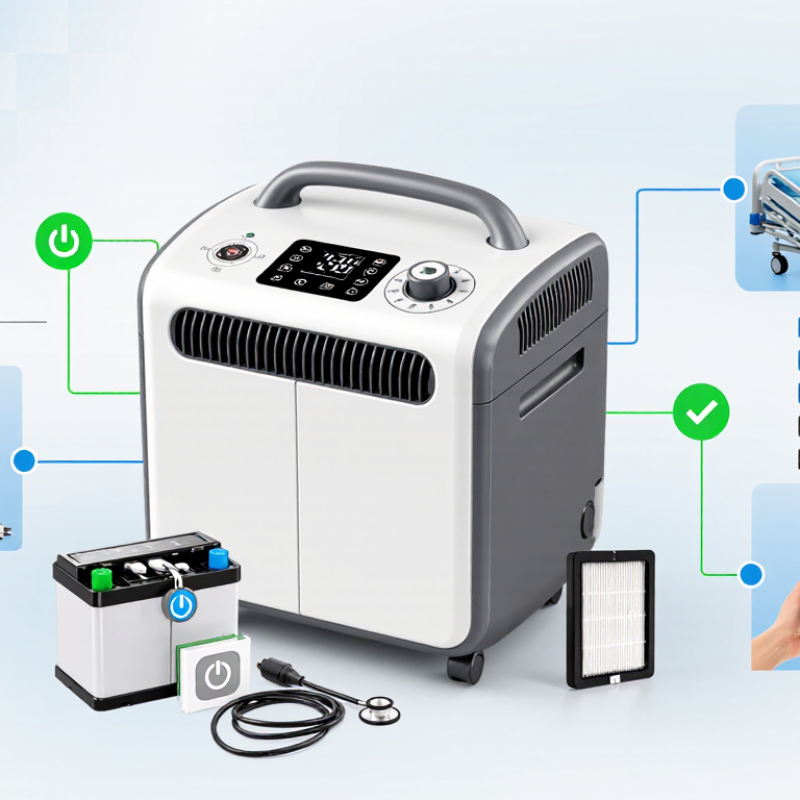
Portable Oxygen Concentrators Explained: PSA Technology and 90–96% Oxygen Purity
What Is the Best Portable Oxygen Generator from China?
Portable oxygen concentrators use pressure swing adsorption, or PSA, to separate oxygen from room air. A compressor pushes air through zeolite molecular sieves. Nitrogen is trapped, while concentrated oxygen reaches the outlet. WHO and UNICEF technical specifications report that concentrators commonly deliver about 82–95% oxygen under rated conditions. Many portable Chinese units advertise 90–96% purity, but that figure depends on flow, temperature, altitude, and battery power.
Purity is not the only performance measure. Check oxygen concentration at each flow setting, especially during continuous use. ISO 80601-2-69 also emphasizes essential performance, alarms, and electrical safety for oxygen concentrators. A reliable test should use a calibrated oxygen analyzer, not only the display. Small details matter. Listen for compressor noise. Inspect sieve-bed replacement access. Confirm battery endurance with the intended flow rate, because laboratory figures can be optimistic.
In practical evaluations, a unit that maintains stable output at two liters per minute may be more useful than one with a higher headline purity. Some models lose concentration near maximum flow. That is easy to miss. The U.S. FDA has also noted that oxygen concentration can decline when equipment lacks maintenance or operates outside specified conditions. Look for clear technical documentation, traceable testing, service support, and compatible input voltage. The best choice is therefore the portable generator with verified 90–96% output under realistic conditions, not simply the lowest price or strongest advertisement.
What Is the Best Portable Oxygen Generator from China? - Portable Oxygen Concentrators Explained: PSA Technology and 90–96% Oxygen Purity
| Portable Oxygen Concentrator Type | PSA Operating Principle | Typical Oxygen Concentration* | Oxygen Delivery | Typical Flow or Setting | Typical Weight | Typical Battery Runtime | Best Application |
|---|---|---|---|---|---|---|---|
| Compact pulse-dose unit | A compressor pushes air through molecular-sieve beds. Nitrogen is adsorbed while oxygen-enriched gas is delivered during inhalation. | 90–96% under rated operating conditions | Pulse dose only | Commonly 1–5 pulse settings; not equivalent to L/min of continuous flow | Approximately 1.5–3.0 kg | Approximately 2–6 hours, depending on setting and battery size | Travel, walking, and daytime mobility for users prescribed pulse-dose oxygen |
| Medium portable unit | Alternating molecular-sieve columns separate nitrogen from compressed ambient air through pressure swing adsorption. | 90–96% at the specified flow and environmental conditions | Pulse dose or limited continuous flow | Pulse settings commonly 1–6; continuous flow commonly 0.5–2 L/min | Approximately 2.5–5.0 kg | Approximately 2–8 hours on a standard battery | Users who need a balance between portability and higher oxygen output |
| Dual-mode portable unit | PSA sieve beds operate in alternating cycles, with valves switching between adsorption and regeneration phases. | Typically 90–96%; concentration may vary with flow, altitude, temperature, and filter condition | Pulse dose and continuous flow | Pulse settings commonly 1–6; continuous flow commonly 0.5–3 L/min | Approximately 3.0–7.0 kg | Approximately 1.5–6 hours, depending on mode and flow | Users requiring greater flexibility for daytime and selected resting conditions |
| High-output portable unit | Larger compressors and multiple sieve beds provide a higher volume of oxygen-enriched gas than compact travel units. | Usually 90–95% at the manufacturer’s rated maximum output | Continuous flow, sometimes with pulse-dose mode | Commonly up to 3–5 L/min continuous flow, depending on design | Approximately 5–10 kg | Often 1–4 hours when battery-powered; AC operation is commonly used | Higher prescribed oxygen demand where portability remains important |
- Confirm whether the prescribed therapy requires pulse-dose delivery, continuous flow, or both.
- Compare oxygen concentration at the intended flow rate rather than relying only on the highest advertised purity.
- Check battery capacity, charging time, AC/DC compatibility, noise level, operating altitude, and alarm functions.
- For products manufactured in China, request independent test reports, electrical safety documentation, oxygen-concentration test data, and warranty details.
*The figures shown are representative technical ranges for portable PSA oxygen concentrators, not guaranteed specifications for every device. Actual oxygen concentration and runtime vary with flow setting, breathing pattern, altitude, ambient temperature, filter condition, battery age, and product design. Oxygen flow and delivery mode should be selected according to a qualified healthcare professional’s prescription.