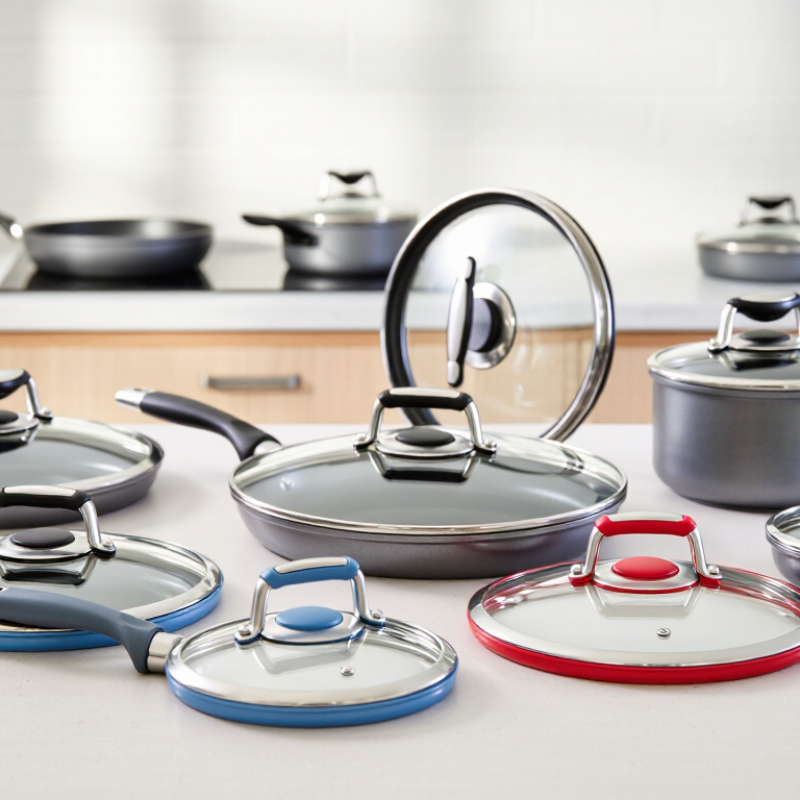
Top Universal Saucepan Lids for Global Buyers

Choosing the right Universal Saucepan Lid sounds simple, but global buyers face many practical variables. Pan diameters differ. Rim shapes vary. Handles can interfere with a lid’s fit. A claimed “universal” design may still leave a narrow steam gap.

Cookware testing expert Lisa McManus has offered a useful principle: “Good cookware should make everyday cooking easier, not more complicated.” That idea guides this overview. We examine lids through real kitchen needs, including compatibility, heat resistance, visibility, storage, and cleaning. A transparent tempered-glass lid can help users monitor simmering sauces without lifting it. A silicone edge may improve the seal around uneven rims. Yet silicone quality differs, and some edges lose firmness after repeated high-heat use.

Fit matters most.

This guide compares Universal Saucepan Lid options for buyers across different markets and cooking habits. It considers common pan sizes, metric and imperial measurements, vent placement, handle comfort, and packaging reliability. Buyers should check the manufacturer’s diameter range instead of trusting a broad product label. That small step prevents loose lids, unstable handles, and unnecessary returns.

There is no perfect universal solution. A lid that fits a 16-centimeter saucepan may sit poorly on a 17-centimeter pan. This limitation deserves more attention. We will also discuss overlooked details, such as condensation collecting beneath the handle and lids becoming awkward in crowded cabinets. The goal is practical guidance, not exaggerated promises, so readers can choose a dependable lid with clearer expectations.

Top Universal Saucepan Lids for Global Buyers

Universal Saucepan Lid Fit: Diameter Ranges, Rim Profiles, and Tolerances

A universal saucepan lid is not truly universal. In purchasing tests, fit depends on diameter, rim geometry, and manufacturing tolerance. Measure the pan’s inside opening, not its outer wall. Record the widest point in millimeters. A 16 cm pan may accept a lid marked 16–18 cm, but only when its rim seats securely. Leave no guesswork.

Look for adjustable rims with enough overlap, but avoid excessive movement. Common rim profiles include flat, flared, and stepped designs. Flat rims suit straight-sided pans. Flared rims need deeper overlap. Stepped rims may catch on pouring lips. A practical tolerance is often 2–4 mm beyond the measured opening, but each design differs. Too little clearance causes wobbling. Too much allows steam and spills to escape.

During sampling, place the lid on a cold pan, then test it with simmering water. Check handle heat, condensation, and rim movement during gentle stirring. I have found printed diameters can be optimistic. That is an uncomfortable detail. Measurements may vary between production batches. Ask suppliers for rim drawings, tolerance data, and fit samples. Test thin rolled edges and heavy cast rims. A reliable lid should lift without vacuum locking. It should stay centered as steam builds. Some buyers overvalue wide coverage. I would reconsider that habit. Coverage alone does not prove compatibility.

Material Safety Compared Under FDA 21 CFR and EU Regulation 1935/2004

Universal saucepan lids need more than a heat-resistant label. Their glass, metal rim, silicone seal, and handle may contact food or condensation. Under FDA 21 CFR, each food-contact substance must be suitable for its intended use, temperature, and food type. Silicone rubber may fall under 21 CFR 177.2600, while plastic components require their own applicable provisions. FDA compliance is not a blanket approval for the complete lid.

EU Regulation 1935/2004 requires materials to avoid harmful migration, unacceptable taste, or odor changes. It also requires traceability through the supply chain. Testing should reflect boiling steam, acidic sauces, oily foods, and repeated dishwasher cycles. The European Commission’s 2023 RASFF report recorded food-contact-material notifications, showing that migration and documentation remain practical risks. A 2024 Grand View Research report estimates the global cookware market will continue growing, increasing demand for verifiable materials. Market growth does not guarantee safer products.

Tips: Ask for migration-test reports, declarations of compliance, and temperature limits. Check every part, not only the lid surface. Look for batch identification and clear care instructions. In my experience, seals often age before glass fails. That detail is easy to miss. Supplier documents can also contain gaps, so independent testing is worth considering for high-volume purchases.

Top Universal Saucepan Lids for Global Buyers - Material Safety Compared Under FDA 21 CFR and EU Regulation 1935/2004
Lid Material Typical Construction Universal-Fit Performance Heat and Durability Profile FDA 21 CFR Considerations EU Regulation 1935/2004 Considerations Food-Contact Risk Best Buyer Use
Borosilicate Glass Tempered or heat-resistant glass disc, often with a stainless-steel rim and steam vent. Excellent
Transparent disc and broad rim can accommodate several pan diameters when the rim is correctly designed.
Good resistance to ordinary cooking temperatures and thermal expansion; vulnerable to impact, edge damage, and sudden thermal shock. Glass food-contact safety depends on composition, coatings, seals, and manufacturing controls. The finished article should be supported by applicable FDA food-contact documentation and extractives or migration data; no blanket FDA approval applies to every glass lid. Must comply with Article 3 of Regulation (EC) No. 1935/2004, including no transfer of substances that endangers health or adversely affects food. GMP under Regulation (EC) No. 2023/2006 and national glass guidance may also be relevant. Low when verified Best for buyers who need visibility during cooking and a premium, neutral-contact surface.
Stainless Steel Single-layer or multi-layer stainless-steel lid, commonly with a rolled edge, handle, and optional vent. Excellent
Rigid rims provide stable support across compatible saucepan diameters.
Highly durable, corrosion-resistant, dishwasher-compatible, and opaque. Heat retention can make handles and knobs hot without suitable insulation. There is no single FDA 21 CFR section that universally approves all stainless-steel articles. Composition, surface condition, intended use, and manufacturing hygiene should be assessed under applicable food-contact requirements, including 21 CFR 174.5 where relevant. Requires compliance with Article 3 of Regulation (EC) No. 1935/2004 and GMP Regulation (EC) No. 2023/2006. Stainless-steel composition and release of metals should be demonstrated using applicable national or sector guidance and testing. Low when verified Best for heavy-duty commercial use, shipping durability, and buyers prioritizing long service life.
Aluminum with Anodized Surface Drawn or spun aluminum lid with a hard-anodized surface, sometimes combined with a stainless-steel rim. Good
Lightweight and easy to size, although rim shape and warping control determine fit.
Low weight and efficient heat response. Anodized surfaces are more resistant to wear than untreated aluminum but can be damaged by aggressive abrasion or alkaline cleaners. Food-contact status depends on alloy, anodizing chemistry, sealants, dyes, and intended food conditions. Supplier documentation and migration or metal-release testing are needed; anodizing alone is not a universal FDA compliance claim. Must meet Article 3 of Regulation (EC) No. 1935/2004. Aluminum release should be evaluated against applicable EU member-state or sector guidance, together with GMP and documented migration or release testing. Low to moderate Best for value-focused buyers seeking low shipping weight and good thermal responsiveness.
Enameled Cast Iron Cast-iron body covered by a vitreous enamel coating, usually with a thick, highly rigid profile. Moderate
Strong but heavy; universal use is limited by weight, rim geometry, and the need for a stable pan match.
Excellent heat retention and high structural strength. Enamel may chip or crack after impact, exposing the underlying metal. The enamel coating, pigments, substrate, and any exposed metal require separate assessment. FDA compliance should be supported by applicable coating or color-additive documentation and finished-product extractives or heavy-metal testing. Must comply with Article 3 of Regulation (EC) No. 1935/2004. Coating integrity, metal release, pigments, and repeated-use migration should be documented under applicable EU requirements and national guidance. Low when intact Best for slow cooking and premium cookware sets where weight is acceptable.
Food-Contact Silicone Flexible silicone cover or silicone-sealed lid, sometimes reinforced with a glass or stainless-steel insert. Excellent
Flexible edges can cover a range of diameters, but sealing performance depends on rim design and elasticity.
Flexible, lightweight, and resistant to many household temperature changes. Performance varies by formulation; tearing, odor retention, and deformation are possible with misuse. Applicable silicone or rubber articles may be evaluated under 21 CFR 177.2600, subject to formulation, extraction limits, and intended repeated-use conditions. The specific formulation and finished article must be verified rather than relying only on a generic “FDA silicone” statement. Must meet Article 3 of Regulation (EC) No. 1935/2004 and GMP Regulation (EC) No. 2023/2006. Silicone composition, volatile substances, catalysts, pigments, and repeated-use migration should be covered by a Declaration of Compliance and test report. Low when verified Best for compact storage, spill reduction, microwave-compatible applications where the complete product is designed for that use, and multi-size coverage.
Stainless Steel with Silicone Rim Rigid stainless-steel center with a flexible food-contact silicone perimeter and insulated or metal handle. Excellent
Combines structural stability with a forgiving rim for several saucepan diameters.
Good balance of impact resistance, flexibility, and washability. The silicone rim is the component most likely to absorb odors, stain, tear, or deform. Both components require evaluation: stainless-steel composition and the silicone rim under applicable FDA food-contact provisions, including 21 CFR 177.2600 when applicable. Adhesives, coatings, pigments, and any assembled interfaces also require review. All food-contact components and the assembled article must satisfy Article 3 of Regulation (EC) No. 1935/2004. GMP, migration testing, and a component-level Declaration of Compliance are recommended for global supply. Low when verified Best overall option for global buyers seeking a practical balance of fit, durability, and storage efficiency.
Plastic or Polycarbonate Insert Rigid transparent or opaque plastic lid, commonly paired with a silicone sealing edge or metal reinforcement. Good
Lightweight and easy to mold, but dimensional stability and heat rating must match the intended saucepan use.
Low weight and impact resistance vary by polymer. Heat distortion, scratching, staining, and chemical stress are formulation-dependent. The exact polymer, additives, colorants, and intended temperature must be identified. Potential FDA pathways may include polymer-specific sections such as 21 CFR 177.1580 for polyolefins or 21 CFR 177.1630 for polycarbonate, where the formulation and use conditions fit those sections. Requires compliance with Article 3 of Regulation (EC) No. 1935/2004 and the applicable EU plastic-food-contact framework, including Regulation (EU) No. 10/2011 when the article falls within its scope. Moderate until verified Best for lightweight retail products, provided the polymer identity, temperature limits, and migration documentation are clear.
Buyer compliance note: FDA 21 CFR and EU Regulation (EC) No. 1935/2004 are not universal product certificates. Compliance depends on the exact material formulation, coatings, colorants, adhesives, food types, contact time, temperature, repeated-use conditions, and manufacturing controls. For international purchasing, request a material specification, food-contact Declaration of Compliance, applicable test reports, use limitations, and traceability documentation for the complete assembled lid.

Thermal Performance: Borosilicate Glass Ratings and EN 13834 Testing

For global buyers, a universal saucepan lid must handle more than boiling water. Borosilicate glass is valued for its low thermal expansion and clearer heat resistance. However, “heat resistant” is not a complete performance rating. Buyers should check the stated maximum temperature, thermal shock limit, and whether the lid is suitable for ovens, stovetops, or both.

EN 13834 testing can provide a useful reference for cookware performance. The test process may assess heat resistance, handle security, coating durability, and resistance to repeated heating cycles. Requirements can vary by product type and declared use. A lid should not be judged by one test result alone. Ask for the test scope, sample conditions, and laboratory documentation. Small details matter.

Look for a lid that survives controlled temperature changes, such as moving from a warm cooking surface to a cooler counter. Sudden contact with cold water remains risky.

Always.

In practical inspections, check the glass edge for chips and examine the rim after repeated use. A metal rim should sit evenly against different pan diameters. Steam vents also deserve attention; blocked vents can increase pressure beneath the lid. I would not treat every borosilicate lid as equally strong. Manufacturing quality, thickness, assembly, and handling can change real performance. The honest weakness is simple: laboratory testing cannot fully copy every household kitchen.

Steam Vents, Handles, and Safety Design Based on ISO 12100 Principles

For global buyers, a saucepan lid should control steam without creating a hidden hazard. ISO 12100:2010 recommends identifying risks during design, use, cleaning, and foreseeable misuse. A practical lid needs a stable steam vent, not merely a decorative hole. The opening should release pressure gradually while limiting hot droplets. Small details matter. A poorly positioned vent can direct steam toward a hand or nearby wall.

The handle deserves equal attention. It should remain cool enough for ordinary handling, provide a secure grip, and resist loosening after repeated washing. A broad, balanced knob is often easier to control with wet fingers. However, “heat-resistant” does not always mean burn-proof. Buyers should examine test methods, temperature limits, and fixing strength. That is not enough. The lid should also sit firmly without sealing so tightly that users struggle to lift it.

Safety performance matters beyond the kitchen counter. The National Fire Protection Association reported that cooking equipment caused 49% of reported U.S. home fires from 2014 to 2018. This does not prove that lids prevent fires, but it supports careful heat and steam management. A transparent lid can improve observation, yet condensation may reduce visibility. A vented lid can reduce pressure, yet excessive venting may dry food faster. No design removes every risk. Buyers should compare ISO 12100-based risk assessments, material declarations, grip tests, and cleaning instructions before choosing a universal model. Personally, I would not trust a lid that looks secure but lacks clear performance evidence.

Global Buyer Checklist: MOQ, Packaging, Incoterms, and ISO 9001 Controls

For global buyers, a universal saucepan lid begins with measurable compatibility, not a broad product claim. Confirm rim diameters, glass thickness, knob clearance, steam-vent position, and carton dimensions. Request a written MOQ for each size, finish, and packaging method. A low MOQ may reduce inventory risk, but it can increase tooling, inspection, and freight costs. I would test this assumption with a landed-cost worksheet. Ask for pilot samples before approving mass production. The ICC Incoterms 2020 rules clarify responsibility for transport, insurance, customs, and delivery points. Choose terms only after checking your broker’s process and destination charges.

Packaging deserves equal attention. Use dividers, corner protection, moisture control, and drop-test records for glass lids. The International Trade Centre’s trade data shows how widely cookware moves across international markets, making transit variation a real purchasing concern. UNCTAD’s Review of Maritime Transport 2023 reports that over 80% of global merchandise trade by volume moves by sea. Delays happen. Specify carton strength, pallet limits, labeling, and replacement procedures in the purchase contract. For quality control, request an ISO 9001 certificate, certificate scope, audit status, and batch inspection records. ISO 9001 proves a managed quality system, not flawless lids. Check actual process evidence: incoming glass inspection, diameter sampling, torque tests, and defect photographs. Some suppliers may provide polished paperwork but weak traceability. That risk needs a physical audit or independent inspection.

Top Universal Saucepan Lids for Global Buyers

Global Buyer Checklist: MOQ, Packaging, Incoterms, and ISO 9001 Controls

This chart summarizes the key quantifiable items buyers should document: one supplier-defined MOQ field, four core packaging specifications, eleven Incoterms® 2020 rules, and seven ISO 9001:2015 requirement clauses from Clauses 4–10. MOQ remains negotiable because no universal international MOQ is defined.

Article Source:

Skip to content