

Choosing the right FISHING TACKLES is a commercial decision, not just a product decision. A crowded wall of lures may look impressive, but slow-moving stock ties up cash and leaves customers searching for reliable basics. Start with the customer. Local fishing habits, seasonal demand, price expectations, and skill levels should shape every buying list.
The American Sportfishing Association’s 2022 economic report estimated that recreational fishing generated $230.5 billion in U.S. economic output and supported 1.3 million jobs. Its 2022 Special Report on Fishing also counted 54.5 million U.S. participants. These figures point to a substantial market, but they do not guarantee sales for any single shop. Product fit still matters. A small retailer near a stocked lake may need dependable hooks, line, and beginner-friendly kits; a specialist store may require premium rods and carefully chosen technical gear.
Glenn Hughes, president of the American Sportfishing Association, is an important industry voice on recreational fishing’s economic value. I cannot verify a verbatim quote from him about tackle selection, so this guide will not invent one. The practical takeaway is clear: match inventory to real angler demand, and review sell-through before reordering. Keep records. Ask customers what they could not find. Even experienced buyers can misjudge a season. This guide explores product quality, supplier reliability, margins, and assortment planning to help businesses make better-informed choices.
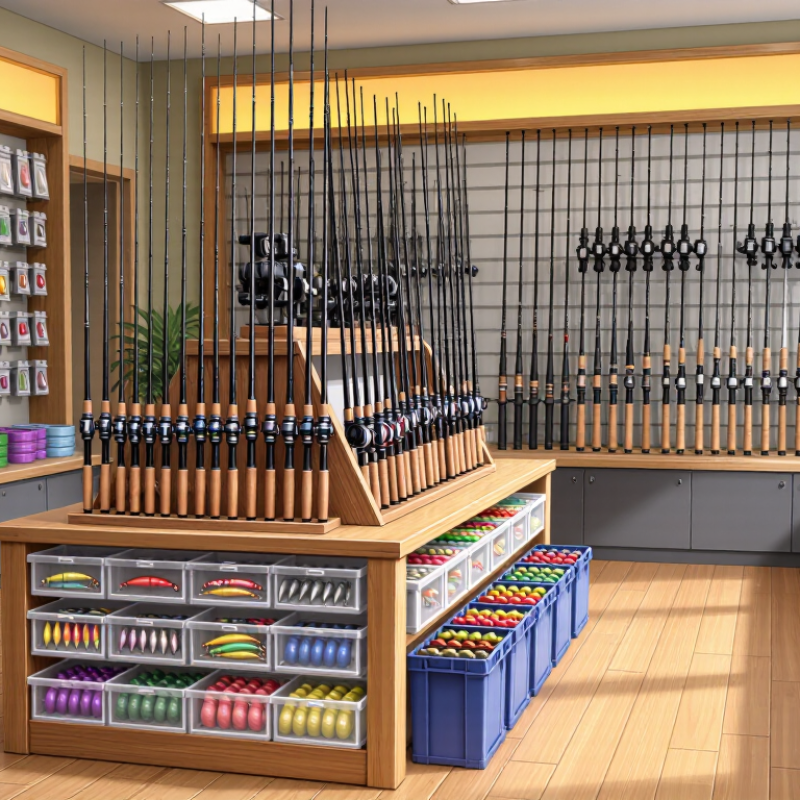
Your tackle selection should reflect how your business earns revenue and whom it serves. A neighborhood shop near a lake may need dependable hooks, line, and basic rigs for weekend anglers. A coastal outfitter may need corrosion-resistant components and heavier leaders, while an online seller could prioritize compact, easy-to-ship assortments. Match stock to actual buying patterns, not a broad idea of what anglers might want.
Talk with customers about where they fish, what species they pursue, and how experienced they are. Beginners often value simple kits, clear sizing, and practical setup advice. Experienced anglers may ask for specialized weights, hook shapes, or line strengths. Review seasonal sales and ask staff to note repeated requests. A spreadsheet helps, though it will not explain every missed sale. That assumption can be costly. Start with a focused range, then adjust based on customer questions, returns, and slow-moving stock.
Tips: Keep a small feedback log at the counter. Record fishing location, target species, skill level, and requested items. Check the notes monthly against sales. Test small. Avoid buying deep inventory after one busy weekend; weather and local conditions can distort demand. If uncertain, ask a knowledgeable local guide or fisheries educator to review your assortment, then document why each category fits your customers.
Build your assortment around the fishing styles customers actually practice nearby, not every category available. Freshwater shops may need dependable rods, reels, line, hooks, sinkers, floats, and basic terminal tackle. Coastal stores often need corrosion-resistant components, heavier line, and tackle suited to local target species. Keep sizes varied, but avoid deep inventory in unfamiliar niche items. Small details matter.
Use sales records, staff conversations, and seasonal patterns to set opening quantities. Pair core items with compatible options, such as medium-power rods, suitable reels, matching line strengths, and useful hook sizes. Display substitutes nearby, since customers may need replacements after losing tackle on rocks or vegetation. Fishing conditions and regulations vary by location, so verify local guidance before making species-specific recommendations. One judgment call may be wrong. Review slow-moving stock monthly and adjust modestly; a neat shelf can hide weak demand.
Tips: Start with a focused range of reliable essentials, then test a few local specialties in small quantities. Track sales by size, not just category. Ask customers what they could not find; their answers may reveal gaps your reports miss.
Choosing fishing tackle for resale means comparing performance, supplier consistency, and the true landed price. In its 2022 National Survey of Fishing, Hunting, and Wildlife-Associated Recreation, the U.S. Fish and Wildlife Service reported 57.7 million U.S. participants fished. The report also recorded $99.4 billion in fishing-related spending. This broad spending figure is not a tackle-only market estimate, but it signals substantial consumer activity. Quality still decides whether customers return. Inspect hooks for uniform points, check reel drag under load, and test line knots with wet hands. Small flaws matter.
Request samples from several suppliers and compare them under the same conditions. Record breakage, finish defects, packaging accuracy, and delivery time. Ask for material specifications and written quality-control procedures; verify claims rather than relying on catalog photos. I have learned that a low quote can hide inconsistent batches. It happens. Compare total landed cost, including freight, duties, packaging, and likely replacement rates, not just unit price. Ask suppliers for minimum order quantities and lead-time ranges in writing. A small pilot order can reveal problems before they reach your shelves. Keep the results, even when they challenge your preferred supplier.
Choose fishing tackle against documented safety criteria, not attractive packaging. Ask suppliers for material declarations, batch traceability, and independent test reports covering sharp points, corrosion, and small components. Requirements vary by product and market, so verify the rules that apply where you sell. The U.S. Fish and Wildlife Service’s 2022 National Survey counted 39.9 million U.S. anglers aged 16 and older. That broad market makes consistent quality important. Small defects matter.
Durability affects returns and repeat orders. Check hook finishes for rust, inspect line for abrasion resistance, and test reel drag under realistic loads. Keep records of sample tests; a single showroom demonstration proves little. Plan seasonal stock with local evidence. NOAA Fisheries’ Marine Recreational Information Program provides monthly recreational fishing estimates, useful for spotting regional activity patterns. Compare those patterns with your own sales, weather, and customer requests before increasing inventory. Peak months differ by location, and forecasts can miss.
Tips: Keep a simple monthly chart of sales, returns, and stockouts. Order proven seasonal items early, but trial unfamiliar tackle in small quantities. Ask for updated test documents when materials or suppliers change.
| Tackle Category | Safety and Compliance Checks | Durability Indicators | Typical Seasonal Demand | Practical Buying Approach |
|---|---|---|---|---|
| Fishing hooks and terminal tackle | Check that points and barbs are securely covered in retail packaging, and that packs include clear handling warnings. Confirm local restrictions on materials such as lead; rules vary by jurisdiction and waterbody. | Inspect hook finish for corrosion resistance, consistent point sharpness, and secure eye formation. For saltwater use, select products specifically described for that environment and verify performance with sample testing. | Demand commonly rises before local open-water fishing seasons and ahead of popular species runs. Patterns vary by species, location, and regulations. | Stock common sizes and styles in depth, with smaller test orders for specialist patterns. Keep regional rules and product-use information available to staff. |
| Fishing line and leaders | Check package labeling for line type, stated breaking strength, length, and intended use. There is no single universal certification that covers all fishing lines; verify claims with suppliers and applicable local requirements. | Compare abrasion resistance, knot performance, memory, and UV-related storage guidance using repeatable in-house checks. Keep spools protected from heat and prolonged direct sunlight. | Demand often increases ahead of open-water seasons and before anglers replace line at the start of a fishing season. Ice-fishing line demand is more location-specific. | Carry a core range of strengths and materials, and replenish fast-selling sizes before local season openings. Track sales by line type and strength. |
| Rods and reels | Check for secure reel-seat fittings, smooth guide edges, stable handles, and packaging that protects rod sections from damage. Do not treat a general product description as proof of a safety certification. | Review blank and guide construction, reel drag operation, corrosion protection, and the availability of replacement parts. Test sample units for repeated casting and retrieval before large orders. | Sales of general-purpose gear often build before warm-weather and open-water seasons. Demand for cold-weather or ice-fishing equipment depends strongly on local conditions. | Balance entry-level and higher-specification options. Use sales history, local fishing calendars, and supplier lead times to plan seasonal inventory. |
| Lures, soft baits, and floats | Check for securely attached components, legible use instructions, and packaging that helps prevent accidental contact with hooks. For products marketed for children, assess applicable children’s-product rules, including U.S. CPSIA requirements or relevant rules in the sales market. | Assess paint or coating adhesion, split-ring and hook attachment, float sealing, and soft-bait resistance to tearing. Store soft plastics according to supplier instructions to reduce deformation or material interaction. | Demand shifts with target species, water temperature, local fishing methods, and seasonal bait patterns; there is no universal peak season for every lure type. | Build assortments around local species and methods. Use small trial quantities for new colors or patterns, then reorder based on sell-through. |
| Waders, gloves, and other fishing accessories | Check size and care labels, seam quality, closures, and clear limitations of use. Do not describe ordinary waders as flotation or personal flotation devices unless the product is specifically certified and labeled for that purpose. | Inspect seam construction, sole bonding, fabric abrasion resistance, and repair options. Confirm care instructions and warranty terms before listing product-life claims. | Wader demand is often stronger before cooler-weather seasons and in regions with year-round stream fishing; gloves and other accessories vary by climate. | Plan sizes and seasonal quantities using local weather and historical sales. Avoid overbuying seasonal sizes until returns and sell-through are understood. |
| Children’s fishing tackle | For products designed or marketed primarily for children in the United States, determine whether CPSIA requirements apply; these can include lead limits, phthalate restrictions for covered products, testing, and certification obligations. Check equivalent rules in other markets. | Check for small detachable parts, sharp exposed points, breakable components, and durable packaging. Ask suppliers for applicable test reports and product documentation. | Demand may rise before school holidays, family travel periods, and local fishing seasons, but varies by region and retail calendar. | Buy only from suppliers able to provide traceable compliance documentation. Keep age guidance and handling warnings clear at the point of sale. |
Plan inventory around local water, season, and customer skill level, not last year’s total sales alone. The U.S. Fish and Wildlife Service’s 2022 National Survey reported 57.7 million Americans fished. That broad audience does not mean every shop needs deep stock in every category. Track sales by item type, size, and month. Compare sell-through with stockouts, returns, and unsold goods. A popular lure that disappears every spring may deserve more shelf space; a slow-moving reel may not.
Review sales weekly during peak periods and monthly in quieter seasons. Keep a simple record of units sold, gross margin, and days in stock. The National Retail Federation’s retail inventory guidance stresses accurate stock records and demand forecasting; even a small spreadsheet can reveal repeat patterns. For example, note whether light line and compact tackle sell faster before local trout season. Ask staff what customers could not find. Their observations help, but they are not a substitute for receipts.
Avoid treating one strong month as a permanent trend. Weather, local access, and shifting customer preferences can distort results. I have seen tidy forecasts miss a sudden change in what anglers ask for. That is worth revisiting. Test small orders of unfamiliar gear, then compare their sales with established items before reordering. Keep enough core stock to serve regular customers, while leaving room to adjust when the evidence changes.
Compare 90-day sales with current stock to identify fast-moving products and potential overstock. These illustrative figures show a realistic example; replace them with your own sales and inventory records before making purchasing decisions.
Products with sales close to or above available stock may need replenishment. Review seasonal demand, supplier lead times, and margins alongside these figures when planning orders.
TERMS OF USE - LEDOLUX
This site uses cookies in order to deliver services in accordance with Privacy Policy. You can use settings within your browser to control the cookies that are set on your computer – conditions of access or storage of cookies.
Your data controller will be LEDOLUX POLAND SP. ul. Innowacyjna 1; 36-060 Głogów Małopolski, which adapts the content of its website to your needs and analyses and examines them to improve it. More information.