

Choosing a reliable CNC Machining Trainer in China requires more than comparing course prices. The right trainer should connect classroom theory with real production demands. Look for experience with milling, turning, tooling, measurement, and modern CNC controllers. A strong program should explain feeds, speeds, workholding, tolerances, and surface finish clearly. It should also include practical sessions beside operating machines.
Inspect the training environment carefully. Does the workshop contain working equipment, calibrated measuring tools, and visible safety procedures? Ask whether learners can practice setting work offsets, loading programs, and correcting tool wear. A useful trainer may show actual parts, such as aluminum brackets or steel shafts, rather than relying only on slides. Trial lessons and factory visits can reveal teaching quality quickly. Bilingual communication also matters when technical terms become difficult.
Check the instructor’s background, customer references, certificates, and after-sales support. Reliable providers should explain course hours, machine models, assessment methods, and maintenance responsibilities in writing. They should not promise instant mastery. CNC skills develop through repetition, mistakes, inspection, and careful adjustment. No shortlist is perfect. A trainer with excellent technical knowledge may communicate poorly, while a friendly instructor may lack deep machining experience. That difference deserves honest attention.
The best choice balances practical experience, professional knowledge, transparent evidence, and learner support. Compare several providers, speak with former students, and request a detailed training plan. Your goal is not merely to operate a machine. It is to build safe, repeatable, and measurable manufacturing skills. Check every detail. Small omissions can become expensive lessons.
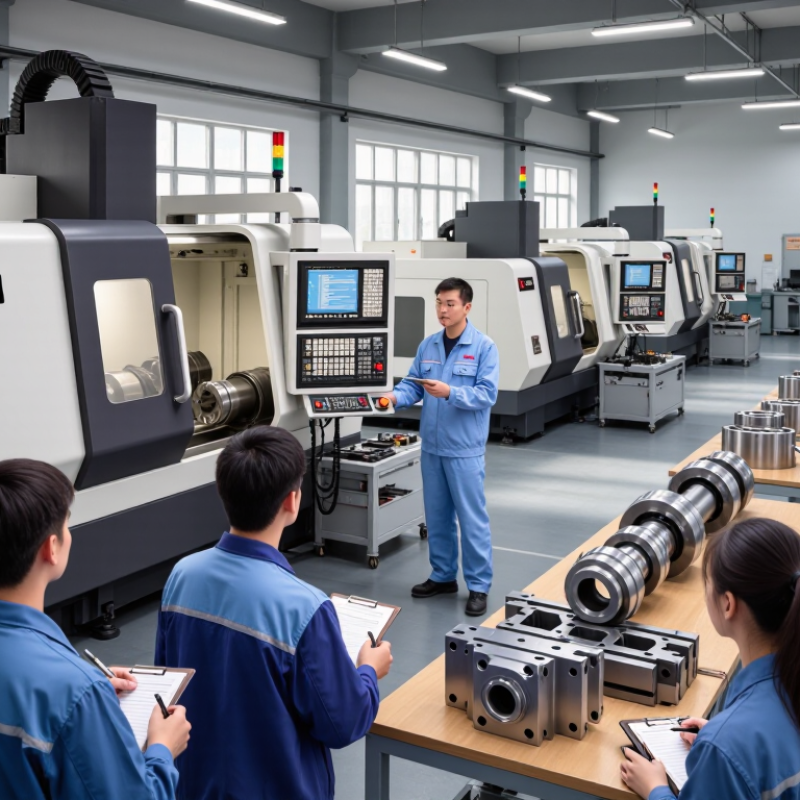
When choosing a CNC machining trainer in China, define the target before comparing classrooms. “Learn CNC” is too vague. Specify machine type, material, tolerance, software, and inspection method. A practical goal might be producing an aluminum housing within ±0.02 mm, reading drawings, and documenting first-article results. Include the trainee’s current level and production schedule. A trainer who teaches advanced five-axis work may be unsuitable for a beginner running three-axis jobs. That mismatch wastes time.
Industry data supports this skills-first approach. The World Economic Forum’s Future of Jobs Report 2023 says 44% of workers’ core skills may change by 2027, while 60% may need training before then. The Manufacturing Institute and Deloitte projected that U.S. manufacturing could create 3.8 million jobs from 2024 to 2033, with 1.9 million potentially unfilled.
These figures do not prove every course is effective. They show why measurable, job-related training matters.
Ask the trainer to map lessons to your requirements. Request a sample lesson, machine access, inspection practice, and assessment records. Check whether instructors can explain cutting forces, tool wear, workholding, offsets, and safe machine operation in clear language.
Verify qualifications through documented projects, learner outcomes, and independent references. A certificate alone is weak evidence.
Keep room for revision. Your first training plan may be too ambitious, especially if drawings, metrology, or troubleshooting are unfamiliar. Short practical tests can reveal that earlier than a final exam.
A strong CNC machining trainer should understand both theory and production pressure. Ask how they set work offsets, select cutting tools, and control tool wear. They should explain feeds and speeds with real material examples, not only textbook formulas. Watch whether they inspect machine alignment, probing accuracy, and coolant flow before cutting. These habits show practical experience. A reliable trainer can also read drawings, explain geometric tolerances, and use inspection results to correct machining errors. Request evidence, such as anonymized project records, sample lesson plans, or measured parts. Be careful with impressive certificates. They may not prove recent shop-floor experience.
Tips: Ask the trainer to demonstrate a short setup using aluminum or steel. Observe their safety checks, measurement methods, and response to an unexpected vibration. Good trainers explain mistakes calmly. They do not hide uncertainty. Ask how they teach beginners to identify chatter, burrs, dimensional drift, and tool breakage. Their answers should be clear and connected to actual production conditions.
Industry experience matters when the trainer has faced changing orders, tight tolerances, and difficult workholding. A trainer who only repeats standard procedures may struggle with unusual parts. I would also ask for references from previous learners or technical managers. However, references can be incomplete. A practical trial lesson is often more revealing than a polished résumé.
A strong CNC trainer in China should be judged by course content, equipment, and practical training. Course content must move beyond G-code memorization. A credible syllabus covers drawing interpretation, GD&T, workholding, tool selection, feeds, speeds, offsets, inspection, and documented correction. The World Economic Forum’s Future of Jobs Report 2023 states that 44% of workers’ core skills may change by 2027. This supports regularly updated lessons. If modules ignore probing, automation, or data-based quality checks, they may already be dated.
Equipment should resemble the machines used in real workshops. The International Federation of Robotics reported 276,288 industrial robots installed in China during 2023, representing 51% of global installations. A useful lab should include CNC mills, turning centers, inspection tools, and basic automation exposure. Students should set a work offset, measure tool wear, read a surface-finish result, and explain a rejected part. Look for calibrated micrometers and visible maintenance records. Shiny machines prove little. Ask to inspect a normal training session.
Equipment should resemble the machines used in real workshops.
Practical training separates confident instruction from useful instruction. Each learner should complete a part from drawing review to final inspection. The trainer should assess setup decisions, safety habits, dimensional control, and response to defects. The World Economic Forum also estimates that six in ten workers will need training before 2027. That makes feedback essential. A failed first setup can teach more than a perfect demonstration. Ask for sample projects, assessment sheets, and evidence of learner corrections.
How to Choose a Top CNC Machining Trainer in China?
A reliable CNC machining trainer should provide verifiable certification, not just a printed course certificate. Check whether instructors hold recognized technical qualifications and recent workshop experience. Their expertise should cover programming, tooling, machine setup, inspection, and workplace safety. Ask to see a sample assessment. A serious program may require students to produce a measured part, correct a tool offset, and explain their G-code decisions.
Student support often reveals more than advertising. Look for small practical classes, clear instruction, and access to machines after demonstrations. Helpful trainers review tool paths line by line and explain why a surface finish failed. Support should continue after class through feedback, troubleshooting, or career guidance. Language assistance can help international learners, but technical clarity matters more. Sometimes, even good courses move too quickly. That deserves honest discussion.
Tips: Request attendance records, assessment rubrics, and graduate work samples. Ask how many hours each student operates a machine. Compare promised outcomes with evidence, such as improved measurement accuracy, safer setup habits, and independent production of a test component. Do not judge success by certificates alone. A learner may pass a written exam yet hesitate beside a running machine. Conversely, a slower student may develop stronger practical judgment. Review the trainer’s correction process, because mistakes handled well can become valuable machining experience.
Recommended evaluation weights for comparing certification, student support, and training outcomes
A balanced selection process should give the greatest weight to measurable training outcomes, including hands-on CNC practice, programming competence, inspection skills, and job-readiness. Certification should be verified for scope and assessment standards, while student support should cover instructor access, equipment availability, feedback, and career guidance.
How to Choose a Top CNC Machining Trainer in China?
A reliable CNC trainer should prove its reputation with evidence, not polished promises. Request recent trainee results, instructor qualifications, workshop photos, and verifiable references. The International Federation of Robotics reported 276,288 industrial robots installed in China during 2023. This figure shows the market’s growing technical demand. Trainers should therefore teach programming, measurement, setup, and safe automation practices. Ask whether lessons use current controllers and real production examples.
Costs need careful comparison. A low fee may exclude materials, machine practice, assessments, or accommodation. Request a written breakdown before enrollment. Check the training location, transport time, workshop capacity, and emergency procedures. Small classes usually offer more machine access, but not always better teaching. The World Economic Forum’s Future of Jobs Report 2023 states that 44% of workers’ core skills may change by 2027. A course without updated content could become expensive quickly. I would also examine enrollment conditions, including language support, required mathematics, attendance rules, refund terms, and certificate verification. Some details are easy to overlook.
Tips: Ask for one sample lesson. Watch how the instructor explains tool offsets and inspection results. Confirm practice hours in writing. Compare total costs, not tuition alone. If answers remain vague, pause. That hesitation is useful.
| Evaluation Dimension | Recommended Benchmark | Typical Evidence to Request | Warning Signs | Practical Rating |
|---|---|---|---|---|
| Training Scope | A complete program should cover CNC safety, technical drawings, coordinate systems, cutting parameters, setup, workholding, tool selection, inspection, and basic troubleshooting. | Detailed syllabus, practical-hour schedule, sample exercises, and assessment criteria. | Only software demonstrations with little or no machine operation. | Essential |
| Practical Training Time | For a beginner, approximately 60–120 supervised practical hours is a useful minimum target for basic operator or setup training. | Machine-to-student ratio, lab timetable, and records showing hands-on practice. | Large classes, shared machine time, or practice limited to observation. | High Priority |
| Instructor Experience | Prefer instructors with several years of documented CNC production, programming, setup, or vocational teaching experience. | Instructor biographies, teaching certificates, technical portfolios, and references from recent learners. | No identifiable instructors or unsupported claims such as “industry expert.” | High Priority |
| Reputation Verification | Check multiple independent reviews, operating history, graduate outcomes, and whether complaints are resolved transparently. | Official registration information, recent learner references, review screenshots with dates, and a written refund policy. | Only anonymous testimonials, pressure to pay immediately, or unverifiable employment promises. | Essential |
| Course Duration | Short introductory courses commonly last about 1–4 weeks; job-oriented operator or programmer programs often require 1–6 months, depending on prior skills. | Start and end dates, weekly hours, attendance requirements, and module completion plan. | An unusually short course promising advanced mastery without practical assessment. | Important |
| Tuition and Extra Costs | Indicative classroom tuition may range from approximately CNY 3,000–15,000 for short or basic programs and CNY 15,000–40,000 for longer job-oriented programs. Actual fees vary by city, equipment, and course length. | Itemized quotation covering tuition, materials, examination fees, accommodation, meals, insurance, and machine practice. | Unclear total price, compulsory add-ons, or non-refundable payments without a contract. | Essential |
| Equipment Access | The facility should provide access to relevant CNC lathes, machining centers, measuring tools, cutting tools, and current control interfaces. | Equipment list, machine photographs or live tour, maintenance records, and practice allocation per learner. | Outdated or unavailable equipment, no inspection tools, or no supervised machine access. | Essential |
| Class Size | A practical class of approximately 8–16 learners generally allows more instructor feedback than a large lecture group. | Maximum class size, instructor-to-learner ratio, and one-to-one assessment arrangements. | A high student-to-machine ratio or no guaranteed practice schedule. | Important |
| Location and Living Cost | Choose a location with convenient transport and access to manufacturing employers. Accommodation and daily expenses are typically higher in major coastal cities than in smaller inland cities. | Exact campus address, nearby housing options, transport time, meal costs, and local safety information. | Remote facilities, hidden accommodation charges, or poor access to public transport. | Important |
| Enrollment Conditions | Basic courses commonly require legal identification, health suitability for workshop work, and minimum age compliance. Advanced courses may require mathematics, drawing, machining, or programming knowledge. | Written admission requirements, language requirements, document checklist, placement test, and visa guidance where applicable. | Verbal requirements that differ from the written enrollment agreement. | Essential |
| Language Support | International learners should confirm whether instruction, safety signage, manuals, and assessments are available in a language they understand. | Sample manuals, interpreter arrangements, bilingual technical vocabulary list, and communication policy. | Marketing material is translated, but classroom instruction is not. | Important |
| Assessment and Certificate | A credible program should include practical testing, dimensional inspection, program review, safety evaluation, and a clearly described certificate. | Assessment rubric, sample certificate, issuing body, certificate verification method, and retest policy. | A certificate is guaranteed merely for attendance or has no identifiable issuer. | High Priority |
| Employment Assistance | Prefer transparent support such as interview preparation, résumé review, employer introductions, and realistic information about wages and job requirements. | Recent graduate employment statistics, written service terms, employer contact records, and limitations of any guarantee. | Guaranteed employment, guaranteed salary, or requests for additional placement fees without written terms. | Important |
TERMS OF USE - LEDOLUX
This site uses cookies in order to deliver services in accordance with Privacy Policy. You can use settings within your browser to control the cookies that are set on your computer – conditions of access or storage of cookies.
Your data controller will be LEDOLUX POLAND SP. ul. Innowacyjna 1; 36-060 Głogów Małopolski, which adapts the content of its website to your needs and analyses and examines them to improve it. More information.