

Choosing the right Stainless Steel Spoon Fork for wholesale requires more than comparing unit prices. Buyers must examine material grade, weight, finish, packaging, and supplier consistency. A polished fork may look attractive under showroom lights, yet show scratches after repeated washing. Practical testing matters.
Experienced wholesalers usually request samples before placing large orders. Hold each piece, check its balance, and inspect the edges around the spoon bowl and fork tines. Food-contact stainless steel should have clear material information, such as 18/10 or 18/0 composition, supported by reliable documentation. The exact grade affects corrosion resistance, shine, strength, and cost.
Small details matter.
Measure the spoon length and fork width against customer expectations. Confirm whether the products suit restaurants, hotels, catering companies, or household retailers. A thin handle can reduce costs, but it may feel weak during daily use. A heavier design can improve perceived value, although shipping expenses may rise.
Supplier evaluation also deserves careful attention. Ask about polishing standards, production capacity, inspection procedures, and replacement policies. Request photographs of packed cartons, not only attractive product images. Independent testing or recognized quality certificates can add confidence, but certificates should be verified carefully. Paperwork alone cannot prove dependable performance.
No checklist is flawless. Even experienced buyers can overlook carton damage or slight design differences between batches. For this reason, clear specifications, pre-shipment inspections, and retained samples provide useful protection. The best wholesale decision balances appearance, durability, customer needs, and total landed cost. It is a practical judgment, not merely a catalog choice.
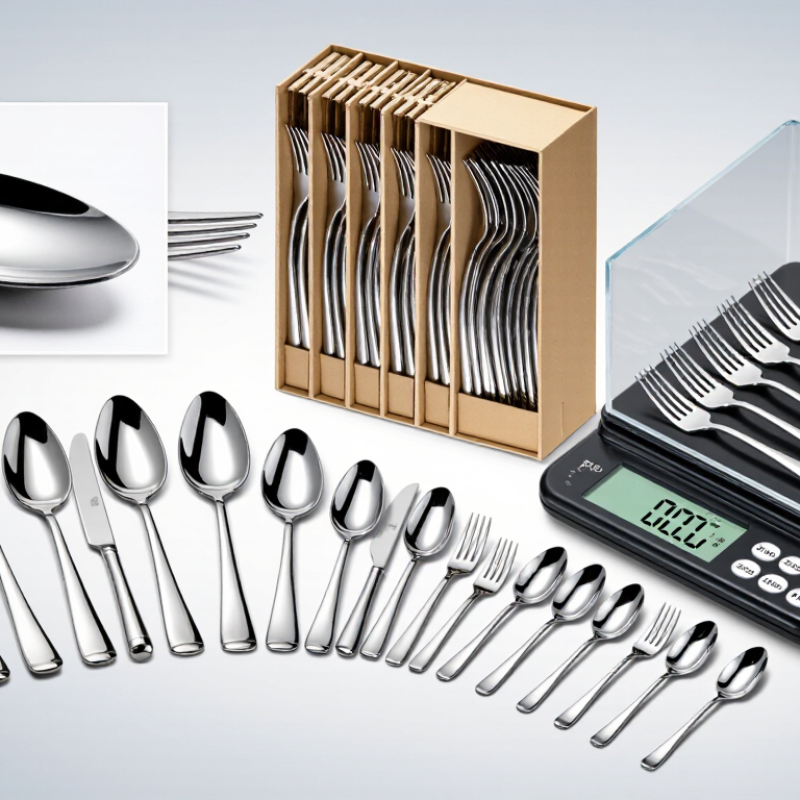
Before choosing a stainless steel spoon and fork for wholesale, define your buyer clearly. A hotel may need heavy pieces for daily buffet service. A café may prefer lighter sets with lower replacement costs. Household retailers often value polished finishes, gift-ready packaging, and affordable pricing. Your target market decides the product, not the factory catalogue.
Grand View Research estimated the global cutlery market at about USD 10 billion in 2023, with steady growth expected through 2030. This indicates broad demand, but market size alone cannot confirm your opportunity. Ask practical questions: What quantity will customers order monthly? Do they prefer 18/0 or 18/10 stainless steel? Will the spoons face dishwashers, outdoor use, or occasional dining? ASTM and ISO references can support material and testing discussions, but buyers should still request inspection records and samples. Reports offer direction. They do not replace experience.
Tips: Create a simple buyer profile before requesting quotations. Record usage, preferred weight, finish, packing method, and target price. Compare at least three samples under real washing conditions. A mirror finish can look impressive, yet it may reveal scratches quickly. That assumption deserves testing. Check carton dimensions too; attractive products can become expensive when freight space is poorly planned. Ask for consistent thickness and polished edges. Small defects become costly at wholesale volume.
When sourcing stainless steel spoons and forks wholesale, grade selection affects lifespan, appearance, and food safety. Grade 304, commonly sold as 18/8 or 18/10, contains about 18% chromium and 8–10% nickel. It resists rust, acidic foods, and repeated washing well. Grade 430 usually contains 16–18% chromium and little or no nickel. It costs less, but may stain sooner in salty or humid environments. World Stainless production statistics have reported annual global output above 55 million tonnes in recent years, showing the material’s importance across food-service equipment and household products.
Durability depends on more than the grade. Check the spoon’s thickness, fork tine alignment, handle strength, polishing quality, and welding marks. A thin 304 fork can bend more easily than a thicker 430 fork. That detail is often missed. For busy restaurants, 304 is generally the safer long-term choice, especially where cutlery faces detergents, salt, and commercial dishwashers. For controlled indoor use, 430 may offer acceptable value after testing.
Safety needs practical verification. The FDA Food Code 2022 describes food-contact equipment as smooth, corrosion-resistant, nonabsorbent, and easily cleanable. Ask suppliers for material certificates, migration test results, and repeated-wash testing. Nickel release also deserves attention for sensitive users. ISO 8442-1 provides relevant requirements for eating utensils, but a certificate does not replace physical inspection. Request samples, inspect edges under bright light, and test several washing cycles. A polished surface can hide weak construction. That is worth remembering.
| Stainless Steel Grade | Typical Composition | Corrosion Resistance | Durability and Hardness | Magnetic Behavior | Food-Contact Safety Considerations | Best Wholesale Applications | Overall Value |
|---|---|---|---|---|---|---|---|
| 304 (18/8 or 18/10) | Approximately 18% chromium and 8–10% nickel. Exact composition depends on the applicable specification. | Very good Resists everyday moisture, weak acids, and normal dishwashing conditions. Not immune to salt or chlorine exposure. | Good toughness and forming performance. Suitable for regular spoon and fork production and repeated commercial use. | Usually non-magnetic when fully solution-annealed; light magnetism may appear after stamping, bending, or cold working. | Widely used for food-contact cutlery when manufactured and finished according to applicable food-contact requirements. | Hotels, restaurants, catering, household sets, supermarket private-label products, and general-purpose wholesale orders. | Excellent balance Reliable quality with broad market acceptance. |
| 316 / 316L | Approximately 16–18% chromium, 10–14% nickel, and 2–3% molybdenum. | Excellent Molybdenum improves resistance to chloride-containing environments, including salty or coastal conditions. | Very good toughness and service life. The higher alloy content does not automatically make it harder than every other grade. | Generally non-magnetic when annealed; processing can produce some magnetism. | Suitable for food-contact applications when the finished product complies with the destination market's regulations and migration limits. | Premium hospitality, marine or coastal locations, salt-heavy food service, institutional kitchens, and premium retail collections. | Premium performance Higher material cost should be justified by the operating environment. |
| 430 | Typically about 16–18% chromium with very low nickel content; ferritic stainless steel. | Good Suitable for ordinary indoor use, but generally less resistant than 304 in chloride-rich or acidic conditions. | Good rigidity and wear resistance for many applications. Lower toughness and formability than austenitic 304. | Magnetic Useful where magnetic separation or a magnetic product check is required. | Commonly used for food-contact products when the grade, surface finish, and manufacturing process meet applicable requirements. | Cost-sensitive restaurant supply, everyday household cutlery, promotional sets, and large-volume wholesale programs. | Strong budget value Good choice when use is moderate and the environment is not highly corrosive. |
| 201 | Chromium-nickel-manganese austenitic stainless steel; nickel is partly replaced by manganese and nitrogen. Composition varies by standard. | Moderate to good Performance depends strongly on the exact chemistry, processing, and surface finish; usually less tolerant of harsh chloride exposure than 304. | Good strength and formability for many stamped products. Long-term performance varies more between suppliers than with established 304 specifications. | Usually non-magnetic when annealed; cold working may create magnetism. | Food-contact suitability must be verified against the exact material specification and destination-market requirements; do not rely on the grade number alone. | High-volume, price-sensitive programs for dry or moderate indoor service where supplier quality control is well documented. | Economical Requires tighter incoming inspection and clearer technical documentation. |
| 410 | Martensitic stainless steel with approximately 11.5–13.5% chromium and low nickel content; exact values depend on the specification. | Moderate Less corrosion resistant than 304 and 316, particularly in salty, acidic, or continuously wet conditions. | High hardness and wear resistance Can be heat treated, but increased hardness may reduce toughness and corrosion resistance. | Magnetic Strongly magnetic in typical conditions. | Use only when the exact grade, heat treatment, finish, and food-contact compliance have been validated for the intended product. | Specialized utensils, components, or applications where wear resistance is more important than maximum corrosion resistance. | Specialized value Usually not the first choice for ordinary spoon and fork collections. |
How to Choose Stainless Steel Spoon Fork for Wholesale?
Evaluate Spoon and Fork Design, Size, and Function
Wholesale buyers should examine the spoon and fork as working tools, not decoration. A useful spoon needs a rounded bowl, steady depth, and smooth edges. The fork needs firm tines with even spacing. Check whether the handle feels balanced in the hand. A heavy handle may look premium but become tiring during long meals. A narrow handle can also reduce comfort. Small details matter.
Match the size to the intended market. A dinner set usually needs a spoon around 19–21 centimeters long. Smaller sizes may suit children, desserts, or compact catering trays. Place several samples together and compare their dimensions. Inconsistent lengths suggest weak production control. Test stacking, drawer storage, and packing space too. These practical checks are easy to overlook.
Function should guide the final decision. Stir soup, scoop rice, and cut soft food with the sample set. The spoon should hold liquid without spilling at the rim. Fork tines should enter food without bending. Inspect welding points, polishing lines, and surface scratches under bright light. Mirror polish attracts attention, but it can hide uneven finishing. Request material declarations and food-contact test reports for the target market. A sample may pass inspection while bulk goods vary. I would require production samples before approving a large order. Even then, recheck random pieces. Mistakes happen.
Evaluate spoon and fork design, size, and function through practical reference dimensions.
Table flatware is commonly specified at approximately 200 mm, while dessert flatware is commonly around 180 mm. A longer functional head improves serving capacity and reach, while a balanced handle thickness supports comfortable daily use. For wholesale orders, confirm the final stainless steel grade, thickness tolerance, edge finishing, weight, and dishwasher resistance with the production drawing.
Manufacturing quality should be checked before discussing price. According to World Stainless, global stainless crude steel production reached 58.4 million tonnes in 2023. This scale does not guarantee suitable cutlery quality. Ask suppliers for the steel grade, material certificates, and production batch records. Food-contact cutlery should align with relevant requirements in ISO 8442-2. Inspect several samples, not just one polished piece. Check spoon bowls for even thickness, smooth edges, and consistent weight. Fork tines should be straight and evenly spaced. Small differences often reveal weak process control.
Finishing affects both appearance and daily use. A bright mirror surface may look premium, but it can hide scratches under showroom lighting. Brush-finished handles should show consistent grain direction. Polished edges must feel smooth against the lips and fingers. ASTM A480/A480M provides useful guidance for stainless steel surface conditions, although finished cutlery still needs product-specific inspection. Test samples after washing, stacking, and repeated handling. Look for water spots, discoloration, loose joints, and rough weld areas. Do not rely on photographs.
Customization should be discussed with measurable details. Confirm handle dimensions, logo placement, engraving depth, packaging materials, and acceptable color variation. Request a pre-production sample and a written approval record. One common mistake is approving decoration before checking balance and grip comfort. It happens. Custom plating or colored coatings can also change cleaning performance. The best wholesale specification includes drawings, tolerances, inspection standards, and replacement terms. A perfect sample is not enough; production consistency matters more.
Wholesale buyers often judge suppliers by polished samples, but daily consistency matters more. Request material certificates, factory photos, and recent inspection records before discussing large volumes. A reliable supplier answers technical questions clearly and admits production limits. I once accepted a low quote too quickly; uneven polishing created extra sorting work. That mistake changed my checklist.
Compare pricing line by line. Ask whether the quote includes molds, surface finishing, carton fees, and export documentation. Confirm the stainless steel grade and thickness in writing. A cheap unit price can hide higher rejection costs. Order a paid sample batch when possible. Ten pieces reveal little. A few hundred pieces show variation.
Packaging deserves practical testing. Shake a sample carton and check for scratches, bent handles, and loose separators. Request inner bags, dividers, or paper sleeves that match your sales channel. Avoid oversized cartons, which waste warehouse space and raise freight costs. Delivery terms need equal attention. Confirm production time, inspection timing, loading port, shipping documents, and responsibility for delays. Add a written tolerance for quantity and defects. Leave room for review. Forecasts change, and rigid schedules can punish both sides. A supplier’s response to a small problem often predicts performance better than a perfect presentation.
TERMS OF USE - LEDOLUX
This site uses cookies in order to deliver services in accordance with Privacy Policy. You can use settings within your browser to control the cookies that are set on your computer – conditions of access or storage of cookies.
Your data controller will be LEDOLUX POLAND SP. ul. Innowacyjna 1; 36-060 Głogów Małopolski, which adapts the content of its website to your needs and analyses and examines them to improve it. More information.