

Choosing the right Parcel Sorting System starts with the parcels your operation actually handles, not a brochure’s headline speed. A system built for uniform cartons may struggle when padded mailers, narrow boxes, and irregular labels share one line. That gap can appear at induction, where parcels rotate, overlap, or arrive faster than staff can feed them.
Before comparing equipment, document daily volume, peak-hour surges, parcel dimensions, weight ranges, and destination mix. Ask suppliers to explain rated throughput under your specific conditions, including scan-read performance and exception handling. A high rated speed may not hold with mixed packaging and frequent recirculation. Small details matter. Check the conveyor footprint, chute capacity, noise, guarding, maintenance access, and connections to your warehouse software. Request a live demonstration using representative parcels, not only clean test cartons.
The best choice balances capacity with accuracy, uptime, staffing, and room to grow. Modular equipment can ease expansion, but added automation also brings costs and service needs. Compare ownership costs, installation disruption, spare-part availability, and operator training alongside purchase price. Ask what happens when a barcode cannot be read or a chute fills. It is easy to overlook these moments. A clear answer can reveal whether the design fits everyday work or only ideal conditions. No single configuration suits every facility; layout, labor, and seasonal patterns change the decision. Use measured site data, documented supplier claims, and a realistic pilot to build a shortlist. Then choose the Parcel Sorting System that meets current needs without making future changes unnecessarily difficult.
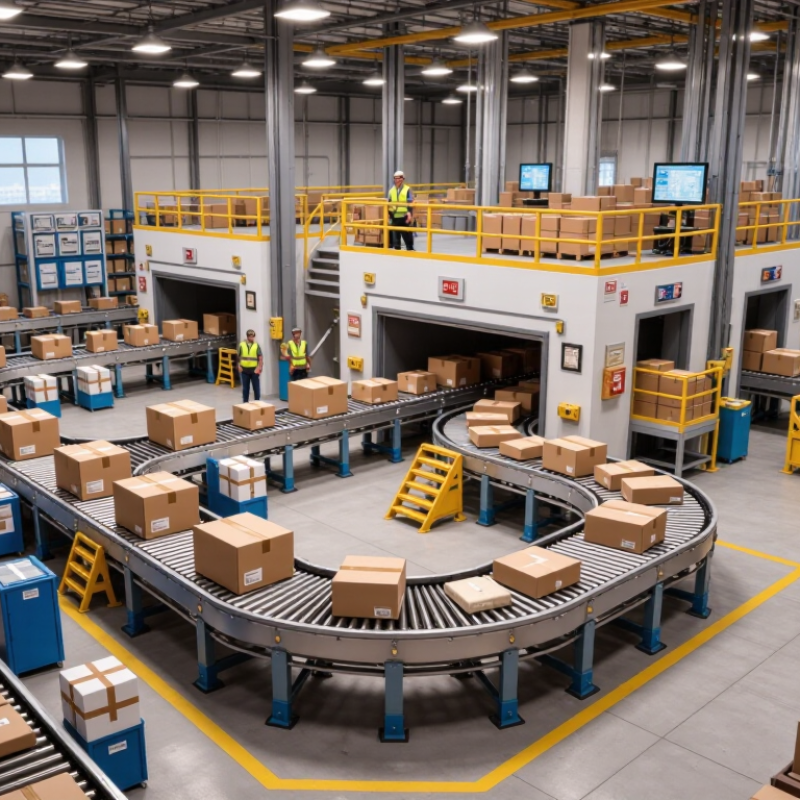
A parcel sorting system is a chain of equipment and decisions, not just a fast conveyor. At the entry point, induction stations feed parcels onto the line at a controlled pace. Singulators separate overlapping items so scanners can read labels clearly. A parcel’s shape, surface, and label position all affect read quality. Small details matter. A crushed corner or wrinkled label can send an item to manual review.
After scanning, control software matches parcel data with a destination and signals a diverter. Belts, rollers, or sliding shoes then direct parcels into the correct chute or lane. Sensors help track movement and detect jams, while guards and accessible stop controls support safe operation. Exception stations are important, too. They give staff a place to check unreadable labels without blocking the main line.
When assessing a system, compare its components with the parcels you actually handle: measure typical dimensions, note weight variation, and observe busy-hour volumes. In practice, an advertised peak rate may not reflect steady daily output, especially when parcels arrive unevenly or labels are difficult to scan. Maintenance access deserves attention as well; a sensor that is hard to reach can turn a minor fault into a long interruption. The right configuration depends on these operating details, and estimates should be checked against real parcel samples.
A parcel sorting system should match the work arriving at your facility, not just a supplier’s stated maximum capacity. Review several weeks of shipment records, including ordinary days and seasonal peaks. Count parcels per hour, but also note how sharply volume rises during busy periods. Averages can hide the pressure. One missed surge can create a queue that lasts into the next shift.
Package variety matters as much as parcel count. Measure common cartons, padded mailers, soft bags, and unusually shaped items. Record their weight, dimensions, and condition; slick bags may slide differently from rigid boxes. Check whether labels remain visible as parcels move past scanners. A system sized around standard cartons may struggle when small mailers bunch together. Oddly, the least common package can still cause frequent stoppages.
Set throughput requirements using the slowest connected step, such as induction, scanning, or manual exception handling. If the sorter moves 3,000 parcels per hour but staff can feed only 2,200, the extra capacity has little practical value. Leave room for maintenance and uneven arrivals. Run a timed trial with representative packages, then inspect mis-sorts, jams, and operator workload. A neat test sample can be misleading; real parcel mixes are rarely so cooperative.
Estimated peak-hour sorting capacity by daily parcel volume
Planning estimate assumes 10 operating hours per day and a peak-hour factor of 1.5; required capacity is calculated as daily volume × 1.5 ÷ 10. These are illustrative sizing estimates, not measured industry benchmarks. Validate them against your actual peak profile and package mix: polybags, irregular items, and bulky parcels may reduce effective throughput compared with standard cartons.
Parcel sorting technology should match parcel mix, peak volume, and available floor space. The 2024 Parcel Shipping Index estimates that global parcel volume reached 161 billion in 2023. That scale makes peak-hour capacity important, but average daily volume alone can mislead. Measure the busiest hour, parcel dimensions, and the share of irregular items before comparing systems.
Cross-belt and tilt-tray sorters suit operations needing many destinations and controlled parcel handling, but require more space and investment. Shoe and pop-up-wheel sorters can fit simpler, lower-cost layouts; performance depends on stable parcel spacing and compatible shapes. A compact loop may save floor area, while a straight-line layout can make maintenance access easier. Neither layout is automatically better.
Configuration matters as much as the sorter. Include singulation, barcode scanning, dimensioning, and an exception lane for unreadable labels or awkward parcels. The 2024 MHI Annual Industry Report found 55% of surveyed supply-chain professionals planned to adopt robotics and automation within five years. Still, automation cannot fix poor induction. A practical test uses real parcels, including soft mailers and scuffed cartons. Models can miss that. Leave room for future chutes, but check that added capacity will not block walkways or service access.
| Sorting technology | How it sorts | Best suited parcel profile | Capacity potential | Key advantages | Main limitations | Typical configuration and fit |
|---|---|---|---|---|---|---|
| Manual sorting | Workers identify parcels and place or route them to the correct destination. | Low volumes, irregular items, exceptions, or operations with frequent process changes. | Low; throughput depends strongly on staffing, parcel presentation, and destination count. | Low initial equipment cost; flexible; straightforward to adapt to changing workflows. | Labor-intensive; performance can vary by shift; limited scalability and consistency. | Sorting benches or chutes with barcode scanning. Often appropriate for small depots, overflow, and exception handling. |
| Belt conveyor with pusher or diverter | A mechanical pusher or diverter transfers parcels from a main belt to an assigned lane. | Regularly shaped parcels that can be conveyed with stable spacing and orientation. | Medium; the number of destinations and spacing between parcels affect achievable rate. | Relatively simple layout; can serve multiple destinations; generally easier to maintain than highly complex sorters. | Some devices are unsuitable for fragile, unstable, or poorly oriented items; transfer points need careful design. | Main belt with one or more divert stations and destination chutes. A common option for regional hubs with predictable parcel flows. |
| Sliding-shoe sorter | Sliding shoes on a moving sorter surface gently push items toward a discharge lane. | Parcels and cartons within the equipment’s specified size, weight, and surface-friction limits. | Medium to high; depends on sorter speed, induction quality, parcel mix, and number of exits. | Controlled side discharge; can support many destinations; suitable for continuous, automated operation. | Requires accurate induction and tracking; irregular or unsuitable items may need a separate handling route. | Loop or linear sorter with barcode scanning, induction stations, and chutes. Often considered for parcel hubs with multiple delivery routes. |
| Cross-belt sorter | Individual belt-equipped carriers move along the sorter and discharge each item sideways at its assigned destination. | A broad range of packaged goods that fit the carrier’s operating envelope; item stability and dimensions still matter. | High; overall performance depends on carrier speed, induction rate, destination layout, and operating availability. | Flexible destination placement; controlled discharge; can handle a varied parcel mix when correctly specified. | Higher equipment and integration complexity; requires reliable tracking, induction, maintenance, and space planning. | Closed-loop or linear system with one or more induction points. Often suitable for large hubs with many destinations and sustained volume. |
| Tilt-tray sorter | Carriers tilt to release items into a chute or onto a takeaway conveyor at the assigned destination. | Items that remain stable on the tray and fall predictably when discharged. | High; depends on tray spacing, speed, induction performance, and destination design. | Can serve many destinations; controlled discharge; useful where items need a defined release point. | Small, round, flexible, or unstable items may not discharge reliably without suitable trays or containment. | Loop sorter with destination chutes and takeaway conveyors. Commonly evaluated for high-volume operations with many sort destinations. |
| Pop-up wheel or roller diverter | Angled wheels or rollers rise through a conveyor surface and redirect parcels to a side lane. | Parcels with a sufficiently flat, stable base and dimensions compatible with the conveyor and diverter. | Low to medium; practical capacity varies with parcel spacing, routing pattern, and merge points. | Modular; can be integrated into conveyor lines; useful for simple lane separation and routing. | Less suitable for soft bags, irregular bases, or parcels that cannot be controlled during a sideways transfer. | Conveyor line with one or more divert modules and side lanes. Often used for smaller facilities or as part of a mixed system. |
Selection note: Capacity is described qualitatively because actual throughput depends on parcel dimensions and weight, barcode readability, induction spacing, destination count, layout, and operating conditions. Confirm the proposed system against measured parcel data and representative trials, including exception and recirculation rates.
A parcel sorting system should fit the building you have, not an imagined future site. Measure clear floor area, ceiling height, and access routes before comparing equipment. Include space for operators, exception handling, and safe maintenance access. A conveyor that fits on a drawing may block a fire door or leave no room to clear a jam. It happens.
Integration deserves the same attention. Map how parcels arrive, where labels are read, and how sorting instructions reach the equipment. Check compatibility with existing scanners, scales, software, and data formats. Run sample parcel records through the proposed workflow, including unreadable labels and duplicate entries. Small gaps can create manual work every shift. A site survey and a controlled trial often reveal issues that a sales specification misses.
Accuracy depends on more than the sorter itself. Parcel shape, label position, lighting, and belt speed can all affect identification and routing. Test with the actual mix of cartons and mailers, not only clean demonstration samples. Track mis-sorts and manual interventions over several operating periods. Maintenance needs matter, too: ask how often belts, sensors, and rollers require inspection, and whether staff can reach them without dismantling nearby equipment. Keep spare parts and service instructions close to the line. The first estimate may be wrong; operating conditions change with seasonal volume. A little humility helps.
A sorting system can look affordable on a quotation and become costly after installation. Compare more than purchase prices. Include conveyors, controls, site preparation, training, maintenance, energy use, and downtime in your estimate. A modest line may suit today’s parcel volume, but peak-season queues can expose its limits. That matters.
Ask suppliers for throughput figures under your actual parcel mix, not ideal test conditions. Record parcel dimensions, weights, and hourly peaks for several weeks. Then model expected growth over three to five years. Check whether extra lanes, scanners, or sorting destinations can be added without rebuilding the floor. Leave space. A layout that fits tightly today may make routine servicing awkward later. Expansion has costs, and forecasts are rarely perfect.
Tips: Compare total costs over the same evaluation period, such as seven years. Request maintenance assumptions and spare-part lead times in writing. Run a small pilot with irregular parcel sizes and realistic staffing during busy periods. If your forecast feels too neat, revisit it.
TERMS OF USE - LEDOLUX
This site uses cookies in order to deliver services in accordance with Privacy Policy. You can use settings within your browser to control the cookies that are set on your computer – conditions of access or storage of cookies.
Your data controller will be LEDOLUX POLAND SP. ul. Innowacyjna 1; 36-060 Głogów Małopolski, which adapts the content of its website to your needs and analyses and examines them to improve it. More information.