

Choosing an External Consumer Unit is not simply a matter of finding a weatherproof box. The right unit must suit the electrical circuits it will protect, the location where it will be installed, and the conditions it may face outdoors. Rain, dust, condensation, and direct sunlight can all affect equipment over time. Details matter.
This guide explains what to check before choosing a unit, including enclosure protection, circuit capacity, available space, and compatibility with suitable protective devices. An IP rating can help indicate resistance to water and dust, but it does not tell the whole story. Installation quality and the exact site conditions matter too. A sheltered wall and an exposed garden wall are not the same.
It can be tempting to focus on price or appearance. That may miss important practical questions: Will the unit accommodate the required circuits? Can it be accessed safely for inspection and maintenance? Is the enclosure appropriate for its position? Not just the price. Because consumer units involve electrical hazards, selection and installation should be confirmed by a qualified electrician familiar with the specific property and local requirements. This advice is general, not a substitute for an on-site assessment. Even careful planning can overlook a small detail, so checking the proposed location and circuit needs before buying is worthwhile.
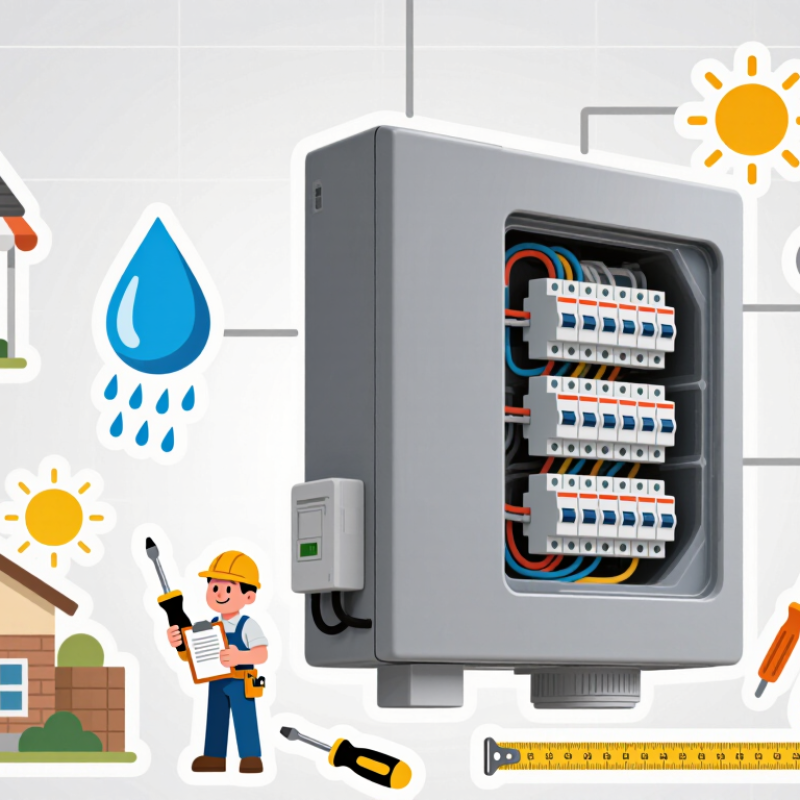
Start with a clear list of every circuit that may connect to the external consumer unit. Include outdoor lighting, garden sockets, a shed, a water pump, or an outbuilding heater. Note what each circuit serves and when it will run. A single light has different demands from several tools used together. Small details matter.
Check the equipment labels and existing circuit information, but do not guess at electrical capacity. An electrician can assess expected loads, cable suitability, protective devices, and whether the proposed arrangement fits the installation. Mention likely future additions, too. It is easy to forget a planned freezer or workshop socket until the unit is already selected. That oversight can mean extra work.
Tips: Write down each appliance, its rated power, and where it will be used. Photograph existing labels if they are readable. Share the list with a qualified electrician before choosing an enclosure or circuit layout. If a device’s rating is unclear, mark it for checking rather than estimating. Some plans change; leave room for a proper review.
Start by listing every circuit the unit will serve: lighting, sockets, outdoor equipment, and fixed appliances. Note each appliance’s rated power and whether several may run together, such as a heater and kettle. A qualified electrician can assess demand, diversity, supply capacity, cable sizes, and earthing. A paper estimate is only a starting point; real usage can surprise you.
Device selection depends on the wiring and the risks, not simply the number of switches. The enclosure also needs protection suited to its location, including rain, dust, and accidental knocks. Check that the proposed rating and layout match the site conditions. Small details matter. If a circuit trips repeatedly, do not treat a larger breaker as a fix; the cause needs investigation. Before choosing a unit, request a load assessment and a clear schedule of circuits and protective devices from a competent electrician.
An external consumer unit needs an enclosure suited to the actual exposure, not just a sheltered-looking wall. IEC 60529 classifies ingress protection with two digits: the first covers solid objects, and the second covers water. For example, IP44 includes protection against objects at least 1 mm wide and splashing water from any direction. IPX5 is tested against water jets. These are test conditions, not a promise that every installation will withstand every storm. Check the product’s stated rating and installation instructions.
Look closely at the location. A unit beneath a deep eave faces different conditions from one beside a garden tap, where spray can strike its underside. Wind-driven rain, dust, direct sun, and condensation also matter. NEMA 250 provides another enclosure-classification system, but its Type numbers should not be treated as direct equivalents to IP codes. A higher water rating may help where washdown or strong spray is expected, yet it does not automatically address corrosion or trapped moisture. I still check the cable entries and cover seal; small installation details can undermine a suitable enclosure. That part is easy to miss. Refer to IEC 60529 and NEMA 250, then have a qualified electrician confirm the enclosure and installation suit the site.
When choosing an external consumer unit, check that it meets the electrical safety standards and installation requirements that apply in your area. Look for clear documentation, not just a reassuring label. The enclosure’s ingress-protection rating should suit its location: a sheltered wall and a spot exposed to driving rain are not the same. A qualified electrician can assess protective devices, earthing, and the condition of the supply before installation. Small details matter.
Materials affect how well the unit holds up outdoors. UV-resistant, corrosion-resistant enclosures can be useful where sunlight, damp, or salty air is a concern. Check that the door closes firmly and cable entries can be sealed correctly. A tight enclosure is not automatically trouble-free; temperature changes can contribute to condensation inside. It is easy to overlook. I would check the proposed mounting position after rain, not only on a dry day.
Think about future capacity as well as today’s circuits. A few spare ways may make later changes easier, but spare space does not increase the supply’s available power. List likely additions, such as a garden office or outdoor equipment, and ask an electrician to check the expected load and required protection. Plans change. Leave room for sensible expansion, while avoiding a larger unit chosen without checking compatibility, installation space, and the existing supply.
How to Choose an External Consumer Unit
Verify System Compatibility and Installation Requirements
Before choosing an external consumer unit, check that it suits the existing electrical supply and intended circuits. Confirm the system voltage, available capacity, earthing arrangement, and required protective devices with a qualified electrician. A unit that fits the wall may still be incompatible with the installation. Small details matter.
Assess the location carefully. A sheltered brick wall and an exposed garden post face different levels of rain, dust, and temperature change. Check the enclosure’s protection rating, cable-entry options, and the manufacturer’s clearance requirements. Plan a route that protects cables from impact and water ingress, without creating awkward bends. Measure twice. Also confirm that the existing upstream protection and circuit layout can support the new unit; adding circuits may require changes elsewhere. I would not treat a weather-resistant enclosure as permission to install it anywhere. That assumption is easy to make, and worth reconsidering. Have a competent electrician inspect the site, verify current installation requirements, and confirm the final arrangement before purchase or installation.
| Selection factor | What to verify | Practical guidance |
|---|---|---|
| Intended location | Whether the unit will be exposed to rain, dust, direct sunlight, condensation, or physical damage. | Choose an enclosure with an ingress-protection rating suitable for the actual environment. Check the rating for the complete installed assembly, including cable entries and any covers; do not assume one rating suits every outdoor location. |
| Enclosure construction | Resistance to corrosion, impact, UV exposure, and temperature changes at the proposed location. | Use an enclosure designed for its installation environment and follow the manufacturer's instructions for mounting, sealing, ventilation, and cable entry. |
| Supply and earthing arrangement | The supply characteristics and earthing arrangement, such as TN-S, TN-C-S, or TT, along with the condition of the existing installation. | Have a qualified electrician confirm that the proposed equipment and protective measures are suitable for the supply. The earthing arrangement must not be assumed from appearance alone. |
| Incoming supply and main switch | Supply rating, service fuse, meter tails, isolation arrangements, and the consumer unit's rated current. | Verify that the equipment rating and incoming connections are suitable for the installation. Cable sizing and protective-device coordination depend on the actual supply and installation conditions. |
| Number of circuits and spare ways | Existing circuits, planned additions, and space for appropriate protective devices. | List the circuits before selecting a unit. Allow practical capacity for planned work, but do not add circuits beyond the enclosure's design or rating. |
| RCD and RCBO protection | Required additional protection, circuit grouping, leakage-current considerations, and compatibility with connected equipment. | Many final circuits require additional RCD protection under the applicable wiring rules. A suitably selected RCBO for each circuit can help limit the loss of supply to unaffected circuits. Device selection must reflect the circuit and its connected loads. |
| Protective-device compatibility | Device type, current rating, breaking capacity, and compatibility with the consumer unit assembly. | Use protective devices specified as compatible with the unit. Ratings and characteristics must be chosen from circuit design calculations, not simply copied from the old installation. |
| Surge protection | Whether surge protective devices are required or appropriate for the installation and its supply conditions. | Assess the need under the applicable wiring rules and consider the equipment being protected. If fitted, ensure the device is compatible with the system and has suitable upstream protection. |
| Mounting position and access | Safe access for operation, inspection, and maintenance, plus clearance from water sources, heat, and foreseeable impact. | Choose a position that permits safe operation and complies with applicable installation requirements. Protect the unit from avoidable environmental and mechanical hazards. |
| Cable entry and sealing | Entry direction, cable-gland requirements, unused openings, and the route of incoming and outgoing cables. | Use suitable glands, seals, and entry arrangements to preserve the enclosure's intended protection. Follow the manufacturer's instructions and avoid openings that could admit water or dust. |
| Standards and verification | Product documentation, applicable assembly standards, and local electrical installation requirements. | Check that the unit is designed for its intended use and is supplied with appropriate documentation. Installation, inspection, testing, and certification should be completed by a suitably qualified electrician in accordance with current local rules. |
Important: Final selection depends on the site's supply, earthing, circuit design, and exposure conditions. Have a qualified electrician survey the installation and confirm compliance before purchase and installation.
TERMS OF USE - LEDOLUX
This site uses cookies in order to deliver services in accordance with Privacy Policy. You can use settings within your browser to control the cookies that are set on your computer – conditions of access or storage of cookies.
Your data controller will be LEDOLUX POLAND SP. ul. Innowacyjna 1; 36-060 Głogów Małopolski, which adapts the content of its website to your needs and analyses and examines them to improve it. More information.