

Top Contact Ball Bearing Manufacturers in China
China is a major source of contact ball bearings for machinery, motors, pumps, and industrial equipment. Yet a supplier’s location alone says little about product quality. Buyers need to compare bearing design, steel and heat-treatment controls, dimensional accuracy, and consistency between production batches. Small details matter. A rough raceway or poorly controlled clearance can affect noise, temperature, service life, and maintenance schedules.
Bearing analyst Tedric A. Harris is known for his technical work on rolling-bearing analysis. Paraphrasing the practical lesson of that work: bearing selection should reflect actual loads, speed, lubrication, and operating conditions. That principle is useful when reviewing Chinese manufacturers, whose capabilities and product ranges vary. Ask for relevant test data, traceable specifications, quality-system information, and clear answers about customization and lead times. A polished catalogue is not enough. Request samples or independent verification when the application justifies it.
This guide introduces leading Contact Ball Bearing manufacturers in China and the factors that distinguish them. It considers product focus, manufacturing experience, quality controls, export support, and suitability for different applications. Rankings and claims should be checked against current records; company capabilities can change, and public information is not always complete. No shortlist replaces technical review. A supplier may be a strong fit for one machine and a poor fit for another. The comparison is a starting point, not a guarantee.
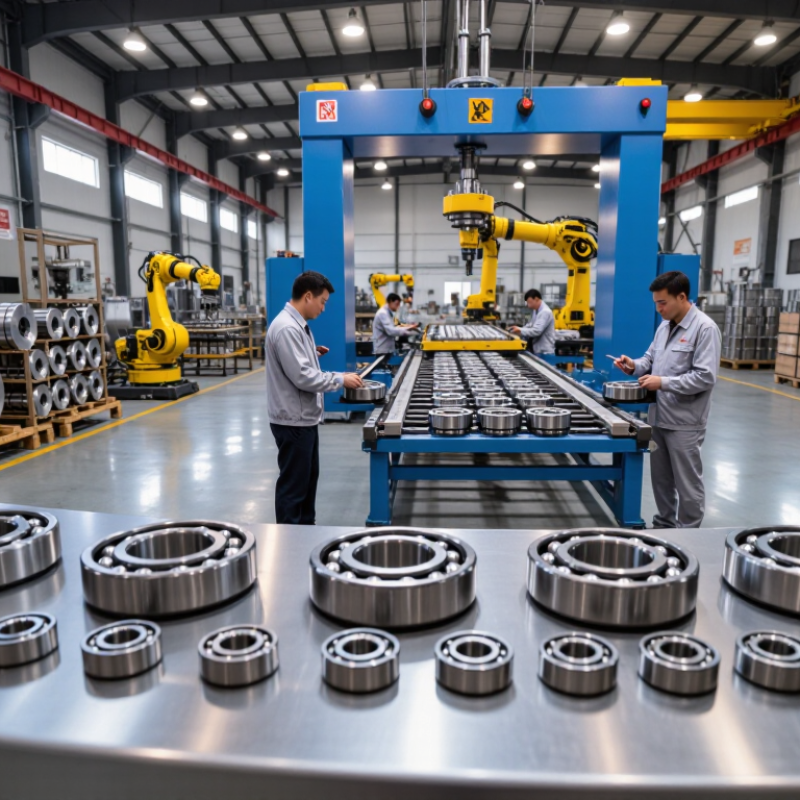
What Contact Ball Bearings Are and How They Work
Angular-contact ball bearings support radial loads and axial loads at the same time. Inside, balls roll between inner and outer raceways, guided by a cage that keeps them spaced apart. The raceways meet the balls at a defined contact angle. That angle matters. A larger angle generally allows greater axial load capacity, while bearing size, speed, and operating conditions also affect performance.
A single-row bearing usually carries axial load in one direction, so pairs are often arranged to handle forces from both directions. During operation, grease or oil forms a thin film between rolling surfaces and helps limit wear. Too little lubrication can cause heat and damage; too much can also raise temperature, especially at high speed. Fit matters. A bearing that is too loose may shift, while excessive interference can distort its raceways. It is tempting to choose by load rating alone, but that misses alignment, temperature, speed, and mounting details. Service life depends on the whole assembly, not just the bearing itself. A careful selection starts with real operating conditions, though those conditions are not always fully known.
| Comparison Dimension | Bearing Design or Feature | How It Works | Typical Uses or Selection Notes |
|---|---|---|---|
| Bearing principle | Angular contact ball bearing | The inner- and outer-ring raceways are offset, creating a contact angle between the balls and raceways. This lets the bearing support radial load and axial load. | Suitable for applications where combined loads, rotational accuracy, or higher speeds are important. Actual capability depends on bearing design, size, lubrication, and operating conditions. |
| Contact angle | Common design options include approximately 15°, 25°, 30°, and 40° | A larger contact angle generally increases axial-load capacity while reducing the bearing's suitability for very high-speed operation compared with a smaller-angle design. | Confirm the specified angle and load direction against the application; available angles vary by bearing series and manufacturer. |
| Single-row arrangement | One angular contact ball bearing | A single-row bearing normally supports axial load primarily in one direction, in addition to radial load. | Often installed in pairs when axial loads act in both directions or when greater rigidity is required. |
| Paired arrangement | Back-to-back, face-to-face, or tandem mounting | Two bearings mounted together can accommodate axial loads in both directions. Back-to-back arrangements generally provide greater moment rigidity than face-to-face arrangements; tandem mounting increases capacity in one axial direction. | Check the specified arrangement, preload, and mounting orientation. Matched pairs are commonly supplied for applications requiring controlled alignment and preload. |
| Double-row design | Double-row angular contact ball bearing | Two rows of balls allow the bearing to support radial loads and axial loads in both directions. | Can simplify assembly where a compact bearing arrangement is useful. Compare speed, load, and space requirements with a paired single-row solution. |
| Four-point contact design | Single-row bearing with a split inner or outer ring design | Its raceway geometry allows axial load to be supported in either direction; it can provide a compact solution where axial-load capacity is a key requirement. | Check radial-load limits and operating conditions for the specific design before substituting it for a paired bearing arrangement. |
| Cage options | Steel, brass, or engineered-polymer cages, depending on the series | The cage spaces and guides the balls. Its material and design affect operating limits, lubrication needs, and suitability for particular temperatures or speeds. | Ask the supplier to identify the cage material and confirm compatibility with speed, temperature, lubricant, and operating environment. |
| Materials and heat treatment | Bearing-grade steel components with controlled heat treatment | Material quality and heat treatment influence hardness, fatigue life, dimensional stability, and resistance to wear. | Review material specifications, heat-treatment controls, and inspection records rather than relying on a generic material description alone. |
| Precision and running accuracy | Manufacturing tolerance and accuracy class | Tighter tolerances can support more precise rotation and controlled runout, but do not by themselves guarantee suitability for every application. | Specify the required tolerance class, runout, and operating clearance or preload in the drawing or purchase specification. |
| Lubrication and sealing | Grease or oil lubrication; open or sealed configurations where available | Lubrication reduces friction and wear. Seals or shields can help retain lubricant and limit contaminant entry, but may affect speed and operating temperature. | Match lubricant type, fill, sealing arrangement, and relubrication needs to the operating speed, temperature, and contamination level. |
| Supplier quality checks | Traceability, dimensional inspection, noise or vibration testing, and process control | Documented controls help verify that bearings conform to agreed specifications and that production batches can be traced. | When comparing manufacturers, request applicable inspection plans, material and process records, product traceability, and sample test reports. |
| Application information | Load, speed, temperature, lubrication, mounting, and service-life targets | These operating factors determine bearing size, arrangement, internal design, and acceptable operating limits. | Provide the full operating conditions when requesting a quotation or technical recommendation; a bearing type alone is not enough to establish suitability. |