

What Is Granular Zinc Oxide Used For?
Granular Zinc Oxide is a solid form of zinc oxide supplied as small, handleable particles. Its purpose depends on the product’s grade, particle properties, and intended process. In manufacturing, it is commonly used as an ingredient in rubber compounds, where zinc oxide supports the vulcanization system. It also appears in ceramics, glass, and other industrial formulations, where it can contribute to product performance or processing.
The granules matter, too. Compared with fine powders, granular material may be easier to store, transfer, and measure, with less airborne dust during routine handling. That can make a difference beside a mixing line, where clean dosing and consistent batches matter. But granules are not automatically dust-free, and their flow or dissolution behavior varies by supplier and application. Small details count.
This guide explains what Granular Zinc Oxide is used for, why manufacturers may choose a granular grade, and how its applications differ across industries. It also covers practical considerations such as specifications, compatibility, storage, and safe handling. A product label alone cannot confirm suitability. Buyers should review technical data and safety information, then check the material against their own process requirements. The term “granular” describes a physical form, not a guarantee of performance. That distinction is easy to overlook.
What Granular Zinc Oxide Is and How It Is Produced
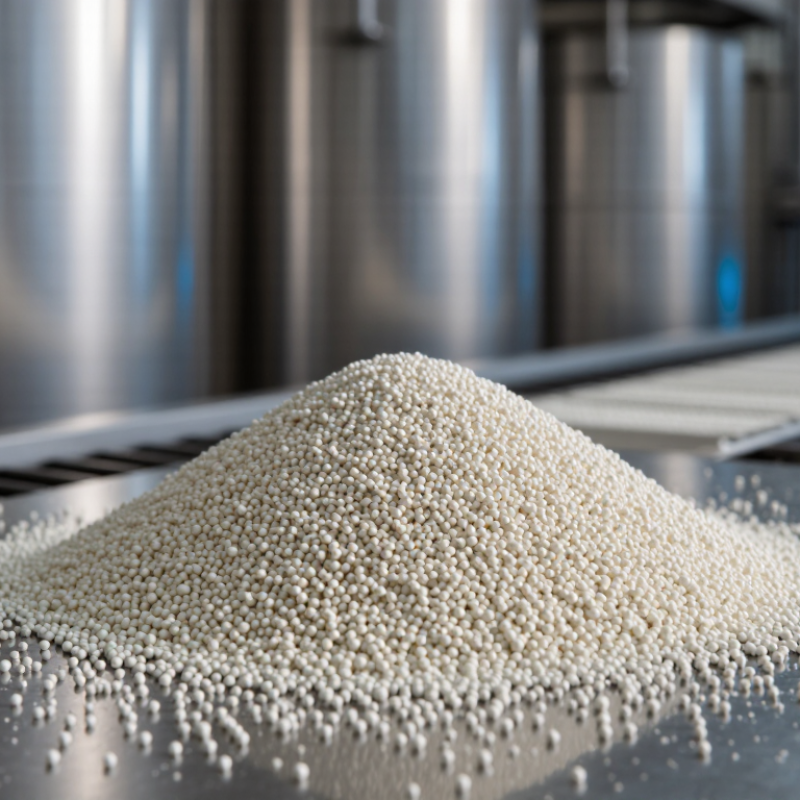
Granular zinc oxide is zinc oxide (ZnO) formed into larger, free-flowing particles. The granules contain the same compound as fine ZnO powder; their shape mainly changes handling. They can reduce airborne dust and make dosing easier in rubber, ceramics, glass, and other manufacturing processes. The granules are not a new compound. Their performance still depends on purity, particle size, and how well they disperse in the final material.
Production generally begins with ZnO powder. In the French process, zinc metal is vaporized and oxidized; other routes use zinc-bearing feedstock. Manufacturers then combine the powder with controlled moisture or a binder and use compaction, extrusion, or similar agglomeration methods. The formed material is dried, screened, and checked for size and strength. USGS’s Mineral Commodity Summaries 2025 estimated global zinc mine output at about 12 million metric tons in 2024. That figure describes zinc ore, not zinc oxide or granular product output, so it is useful only as feedstock context. Granules can also break during transport, a practical weakness worth testing.
Tips: Ask for particle-size and dust data, then test a small batch in your process. Check carefully.
| Category | Details | Why the Granular Form Matters | Typical Considerations |
|---|---|---|---|
| Material Overview and Production | |||
| What it is | Granular zinc oxide is zinc oxide (ZnO) formed into larger, free-flowing particles. It is a processed physical form of ZnO, not metallic zinc. | Compared with fine powder, granules can be easier to pour, convey, and meter, and may generate less airborne dust during handling. | Granule size, strength, porosity, and flow behavior depend on the product and manufacturing process. |
| French process | Zinc metal is vaporized and oxidized in air; the resulting zinc oxide is collected as a fine powder. | The powder may subsequently be agglomerated or compacted into granules for handling or processing needs. | This is also known as the indirect process. Granulation is a separate finishing step, not the oxidation reaction itself. |
| American process | Zinc-bearing materials are heated with a carbonaceous reducing agent to produce zinc vapor, which is then oxidized to zinc oxide. | As with the French process, the resulting oxide can be conditioned into granules after production. | This is also known as the direct process. Feed materials and process conditions affect the product’s composition and properties. |
| Granulation and finishing | Fine ZnO can be made into granules through processes such as agglomeration or compaction, followed by drying and screening when required. | Screening can provide a more consistent particle-size range for a particular handling or dosing system. | Binders, moisture, and processing conditions vary by product; the granules should be checked against the intended application’s specifications. |
| Basic material properties | ZnO is typically a white solid, has low solubility in water, and has a crystal density of about 5.6 g/cm³. | Granule bulk density is different from crystal density and varies with particle size, shape, and packing. | Use the supplier’s product data for application-specific values such as particle size, bulk density, purity, and moisture. |
| Common Uses of Zinc Oxide | |||
| Rubber and tire compounds | ZnO is used as an activator in many sulfur-cured rubber formulations, helping the vulcanization system work effectively. | Granules can simplify transfer and metering in production areas where dust control and consistent feeding are important. | The required amount depends on the rubber formulation and applicable product requirements; it is not a universal fixed dose. |
| Ceramics and glass | ZnO can serve as a raw material or functional oxide in selected ceramic bodies, glazes, and glass compositions. | Granules may be convenient for bulk storage and charging, but they generally need to be compatible with the batch’s mixing and melting process. | Its effect depends on the full formulation and firing conditions; not every ceramic or glass product uses ZnO. |
| Animal nutrition | Feed-grade zinc oxide can be used as a source of zinc in animal-feed formulations where permitted. | A granular or otherwise free-flowing form may help with handling and controlled addition to a feed mix. | Use only material that meets applicable feed-grade requirements, and follow local regulations and formulation guidance. |
| Chemical and materials manufacturing | ZnO is used as a zinc-containing raw material in the manufacture of various zinc compounds and other formulated materials. | Granules may be selected to suit bulk handling, feeding, or dust-management needs at a plant. | Suitability depends on purity, reactivity, particle characteristics, and the downstream process. |
| Personal-care and topical products | Specifically prepared zinc oxide is used in some topical products, including skin-protective formulations and sunscreens. | Granular industrial material is not automatically suitable for direct use in these products; it may require further processing and controlled dispersion. | Cosmetic or pharmaceutical applications require appropriate grade, safety, quality, and regulatory compliance. |
Note: “Granular” describes the physical form, not a single standardized grade. Confirm the product specification and regulatory suitability before choosing zinc oxide for a particular use.