

Choosing the best Powder Feeder from China requires more than comparing prices and catalog photos. Powder behavior changes with humidity, particle size, density, and storage time. A material that flows smoothly in the morning may bridge inside a hopper by afternoon. That difference can damage accuracy and production stability.
Andrew Jenike, a pioneer in bulk-solids engineering, is widely credited with stating, “The flowability of a bulk solid is not a material property; it is a system property.” This principle remains important when evaluating Chinese manufacturers. Ask whether the supplier has tested your actual powder, not only a similar sample. Review feeding accuracy, screw design, agitation, hopper geometry, contact materials, and cleaning access. Request test records with clear operating conditions. Numbers without conditions can mislead.
Look closely at manufacturing experience. Does the supplier provide calibration procedures, inspection reports, spare-parts support, and documented quality controls? Stainless-steel welds should appear clean and consistent. Electrical components should match your facility requirements. Food, pharmaceutical, and chemical applications may require different documentation and material certifications. Confirm these details before payment.
A factory visit helps.
Still, it is not enough.
I have seen technically impressive feeders fail because operators could not clean them quickly. I have also seen lower-cost equipment perform well after proper powder testing and commissioning. This is where buyers sometimes misjudge the decision. The cheapest Powder Feeder may become expensive through waste, downtime, and repeated adjustments. A careful selection process should balance accuracy, reliability, service response, compliance, and total ownership cost. The best choice is not merely made in China; it is proven under your real production conditions.
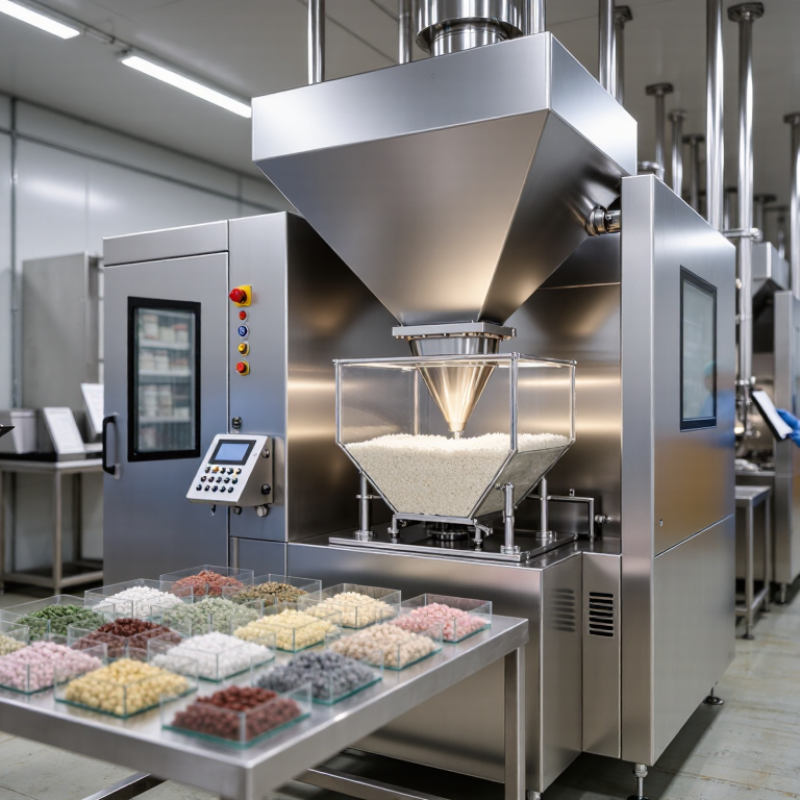
Choosing the best powder feeder from China starts with defining the powder itself. Is it free-flowing, cohesive, abrasive, dusty, or moisture-sensitive? A fine mineral powder may bridge above the screw, while plastic granules can flow smoothly through the same hopper. Ask for bulk density, particle size, temperature, and moisture data before comparing equipment.
Throughput determines the feeder’s working range. Small laboratory dosing may require only 0.1 kg/h, while continuous industrial lines can demand 10,000 kg/h. Do not select a feeder only by its maximum rating. A unit designed for 10,000 kg/h may perform poorly at 0.1 kg/h. Check the minimum stable rate, motor resolution, hopper design, and refill method. Request a material trial using your actual powder. Test it.
Accuracy also depends on process conditions. Loss-in-weight systems can control dosing precisely, but vibration, dust buildup, and uneven refilling can distort readings. Volumetric feeders may suit stable bulk density, yet density changes can create dosage errors. During factory evaluation, inspect calibration records, weighing sensors, seals, and emergency shutdown functions. Ask for repeated test results at low, medium, and high rates. One successful run is not enough. Chinese suppliers may offer strong customization, but drawings and performance claims still require careful technical review. Leave room for improvement; powder behavior often changes after installation.
Volumetric feeders usually achieve ±1–2% accuracy when powder density remains stable. They measure volume, not mass. This design suits free-flowing powders with consistent particle size. It also offers a lower purchase cost and simpler maintenance. However, humidity, vibration, and hopper level can change bulk density. The result may drift during a long production run. Powder & Bulk Solids’ 2024 bulk-handling survey highlights material variability as a persistent operating challenge. That detail matters more than a catalog percentage.
Gravimetric feeders weigh the discharged powder continuously. Their practical accuracy can reach ±0.5% under controlled conditions. Load-cell resolution, refill timing, calibration, and vibration isolation determine the real result. A factory audit should request test records using your actual powder, not generic flour or plastic pellets. ISO 5725-1 separates repeatability from trueness, so one successful test proves little. Ask for both figures. PMMI’s 2024 automation trends report also identifies data visibility as a growing equipment priority. Choose a controller that records weight, alarms, and calibration history. It costs more. It can reduce overfeeding, rejected batches, and manual adjustments. Still, ±0.5% is not guaranteed in every installation. Moisture changes remain difficult. That is where careful trials often reveal uncomfortable truths.
How to Choose the Best Powder Feeder from China?
Powder flowability should guide feeder selection, not price alone. The Carr Index compares bulk density with tapped density. The formula is: (tapped density − bulk density) ÷ tapped density × 100. A value below 20% generally indicates good flow. For example, densities of 0.50 and 0.60 g/mL produce a Carr Index of 16.7%.
USP General Chapter <1174>, Powder Flow, recommends combining density testing with practical observations. ASTM methods also stress consistent sampling and controlled testing conditions. Test the powder at production humidity, not only in a dry laboratory. A small change in moisture can cause bridging, rat-holing, or unstable feeding. Watch the discharge point closely.
For a 16.7% Carr Index, a standard loss-in-weight or twin-screw feeder may provide steady dosing. Powders near 20% need more attention. Check the hopper angle, agitator speed, screw geometry, and refill behavior. Ask Chinese suppliers for repeatability data, calibration records, and tests using your actual powder. Request results from at least ten feeding cycles. That sample is still limited, but it reveals drift better than one impressive trial.
Do not treat “below 20%” as a guarantee. Particle shape, electrostatic charge, and segregation can change performance. Request factory acceptance testing before shipment. Include feeder accuracy, throughput range, cleaning access, and spare-part availability in the specification. A cheaper feeder may become expensive after installation.
How to Choose the Best Powder Feeder from China?
A supplier’s certificate is only useful when its scope matches your powder feeder. The ISO Survey 2022 recorded 1,265,216 ISO 9001 certificates worldwide. That number shows broad adoption, not automatic quality. Ask for the certificate number, legal entity, site address, expiry date, and covered activities. Verify them through the certification body’s public database. Check whether manufacturing and final inspection occur at the same facility. I have seen documents with correct logos but mismatched addresses. That small gap deserves attention.
CE compliance requires more than a logo on the machine. Request the EU Declaration of Conformity, applicable regulations, risk assessment, technical file index, and test reports. Confirm the declaration identifies the exact model and current manufacturer details. The European Commission’s Safety Gate Report 2023 recorded 3,412 product alerts across consumer markets. These alerts do not specifically measure powder feeders, but they show why traceable compliance matters. A copied declaration is not evidence.
For pharmaceutical or food applications, request GMP-related procedures, material certificates, cleaning records, calibration logs, and change-control documents. GMP is a quality system, not a single universal certificate for every machine. Ask how the supplier prevents cross-contamination and verifies dosing accuracy. Request a factory video, sample inspection, and witnessed test. The uncomfortable truth is that paperwork can still hide weak production control. Treat documents as starting evidence, not final proof.
| Compliance Area | Document or Evidence to Request | What to Verify | Relevant Standard or Requirement | Practical Decision Rule |
|---|---|---|---|---|
| Quality management system | Current ISO 9001 certificate, including certificate number, issue date, expiry date, certification scope, and issuing certification body | The legal entity and manufacturing site on the certificate must match the supplier being evaluated. Confirm the certificate through the certification body’s online directory or written confirmation. | ISO 9001:2015 quality management system requirements | Accept only when the scope covers the design, manufacture, or servicing activity relevant to the powder feeder. |
| ISO certificate validity | Certificate copy plus the latest surveillance-audit or recertification information, where available | Check that the certificate is not expired, suspended, withdrawn, or issued only for a trading office rather than the production facility. | Certification-body certification and surveillance procedures | Treat an unverifiable or expired certificate as unconfirmed until independently validated. |
| CE conformity | EU Declaration of Conformity, technical file summary, risk assessment, user manual, and applicable test reports | Confirm the exact model, product description, applicable EU legislation, harmonised standards used, manufacturer details, signature, and declaration date. | For machinery, commonly the Machinery Directive 2006/42/EC during its applicable transition period; also assess EMC and Low Voltage requirements where applicable. Verify the current legal framework for the shipment date. | Do not accept a CE logo alone. Require a product-specific Declaration of Conformity and supporting technical evidence. |
| Notified-body involvement | Notified-body certificate or examination record, only when required by the applicable EU conformity route | Check the notified body’s four-digit identification number and confirm its scope in the EU NANDO database. | Applicable EU conformity-assessment legislation | A notified-body certificate is not automatically required for every powder feeder; the need depends on product classification and conformity route. |
| GMP suitability | GMP statement, hygiene design specification, material certificates, cleaning instructions, and applicable validation or qualification records | Determine whether the feeder will contact pharmaceutical, food, cosmetic, or other regulated product. Match the evidence to the destination market and product category. | Applicable GMP framework, such as EU GMP for medicinal products or relevant food-hygiene requirements | Do not treat “GMP certified” as a universal machine certificate; verify the specific regulatory basis and intended use. |
| Product-contact materials | Material certificates, surface-finish data, elastomer declarations, and coating or lubricant specifications | Check material grades, traceability, corrosion resistance, surface finish, and suitability for the powder being handled. | Destination-market food-contact or pharmaceutical-contact requirements, where applicable | Require documented material traceability for all product-contact parts before approving a regulated application. |
| Traceability and change control | Batch or serial-number procedure, bill of materials, revision history, nonconformance process, and change-notification procedure | Verify that critical components, software, materials, and design changes can be identified and communicated. | ISO 9001 documented-information and operational-control principles; additional GMP expectations where applicable | Prefer suppliers that commit to written notification and approval for changes affecting fit, function, or compliance. |
| Performance verification | Factory acceptance test procedure, calibration records, dosing-accuracy results, repeatability data, and powder-specific trial report | Check test conditions, powder characteristics, feed rate, accuracy tolerance, repeatability, operating range, and acceptance criteria. | Contract specifications and validated customer requirements | Approve only against documented tests using a powder and operating range representative of the intended process. |
| Electrical and machine safety | Electrical schematic, protective-earth test, insulation or dielectric test, emergency-stop verification, guarding assessment, and risk assessment | Confirm that the documentation matches the supplied voltage, control system, motor, sensors, guards, and actual machine configuration. | Applicable machinery, electrical-safety, and electromagnetic-compatibility requirements | Reject generic reports that do not identify the supplied model or configuration. |
| Document authenticity | Original PDF files, verification links, issuing-body contact details, signed declarations, and document revision list | Compare names, addresses, model numbers, dates, signatures, certificate identifiers, and technical specifications across all documents. | General supplier due-diligence and document-control practice | Escalate inconsistencies for written clarification before placing an order or approving a sample. |
| Final supplier qualification | Completed compliance checklist, signed technical agreement, approved drawings, inspection plan, and agreed corrective-action process | Confirm that compliance documents, product specifications, testing responsibilities, warranty terms, and change-control obligations are included in the purchase documentation. | Buyer’s quality agreement and destination-market regulatory requirements | Select the supplier with independently verifiable evidence and documented product-specific controls, not merely the lowest quoted price. |
A reliable factory trial should use your actual powder, not a convenient substitute. Request tests with different moisture levels, particle sizes, and feed rates. Record accuracy, cleaning time, bridging, and restart behavior. In my experience, a feeder can look excellent for twenty minutes and struggle after six hours. Ask for raw test videos, calibration records, and signed performance data.
Calculate total cost beyond the purchase price. Include freight, commissioning, energy, calibration tools, downtime, and operator training. A low-cost unit may become expensive when one custom sensor stops production. Request a spare-parts list with prices, stock locations, and expected service life. Check whether common seals, motors, and load cells have standard alternatives.
Support response time deserves a written service-level target. Ask for maximum reply hours, remote troubleshooting availability, and escalation contacts. Require manuals in clear technical English. ISO 9001 certification supports process control, but it does not guarantee useful support. Test the supplier with a difficult question before ordering. Delayed answers are evidence. I would also request a video call during factory acceptance. It may feel excessive, yet missed details often become expensive lessons.
TERMS OF USE - LEDOLUX
This site uses cookies in order to deliver services in accordance with Privacy Policy. You can use settings within your browser to control the cookies that are set on your computer – conditions of access or storage of cookies.
Your data controller will be LEDOLUX POLAND SP. ul. Innowacyjna 1; 36-060 Głogów Małopolski, which adapts the content of its website to your needs and analyses and examines them to improve it. More information.