Top 10 Mini Pleated ULPA Air Filter Types for Global Buyers
Global buyers need more than a high-efficiency label when selecting a Mini-Pleated Ulpa Air Filter. They need verified performance, stable supply, and practical installation details. This introduction frames the top ten filter types through those priorities. It considers separatorless designs, aluminum-separator models, compact box filters, gasketed units, gel-seal versions, V-bank configurations, PTFE-media filters, fiberglass-media filters, terminal modules, and customized cleanroom assemblies.
Dr. Jeffrey Siegel, a recognized indoor-air-quality and filtration researcher, offers a useful warning: “There is no silver bullet when it comes to indoor air quality.” His point applies directly to ULPA selection. A filter with excellent MPPS efficiency may still create excessive pressure drop, increase fan energy, or fit poorly inside a crowded housing. Small details matter. A 305 × 305 mm frame, a damaged gasket, or an uneven pleat pack can change real performance.
This guide compares efficiency, airflow, pressure drop, media construction, sealing methods, service life, and certification evidence. Buyers should review EN 1822 or ISO 29463 reports, not rely only on supplier marketing language. Some product names overlap across regions. That creates confusion. It also deserves honest attention.
The best Mini-Pleated Ulpa Air Filter is not automatically the most efficient model. It must match the air volume, contamination level, equipment design, maintenance plan, and operating budget. Specifications can mislead. Field conditions can be less tidy. Careful verification remains essential for reliable global purchasing.
What Defines Mini Pleated ULPA Air Filters
Mini pleated ULPA air filters are compact, high-efficiency filters designed for spaces where particle control matters. Their defining feature is the pleated media, which creates more filtering area inside a small frame. This design supports strong particle capture without requiring a large housing. Very compact.
ULPA performance is normally verified against the most penetrating particle size, but testing methods can differ by standard. Buyers should request efficiency data, airflow results, and pressure-drop curves. A dependable specification also identifies the filter’s dimensions, frame material, gasket position, and sealing method. These details affect installation reliability. A perfect media rating means little when air bypasses the gasket.
In practical selection, check how the filter behaves at the intended airflow, not only its headline efficiency. A narrow mini filter may show excellent capture while creating higher resistance. That can increase fan energy and reduce ventilation if the system is undersized. Pleat depth, spacing, adhesive quality, and protective mesh also deserve inspection. A damaged corner can become a real leakage path.
Experienced buyers often compare factory test reports with independent inspection results. This step reveals measurement gaps and inconsistent terminology. Still, no filter choice is universal. Cleanrooms, medical equipment, laboratories, and compact air handlers may require different balances between size, pressure drop, service life, and sealing. The confusing part is that smaller does not always mean simpler.
The Ten Main Mini Pleated ULPA Filter Types
Top 10 Mini Pleated ULPA Air Filter Types for Global Buyers
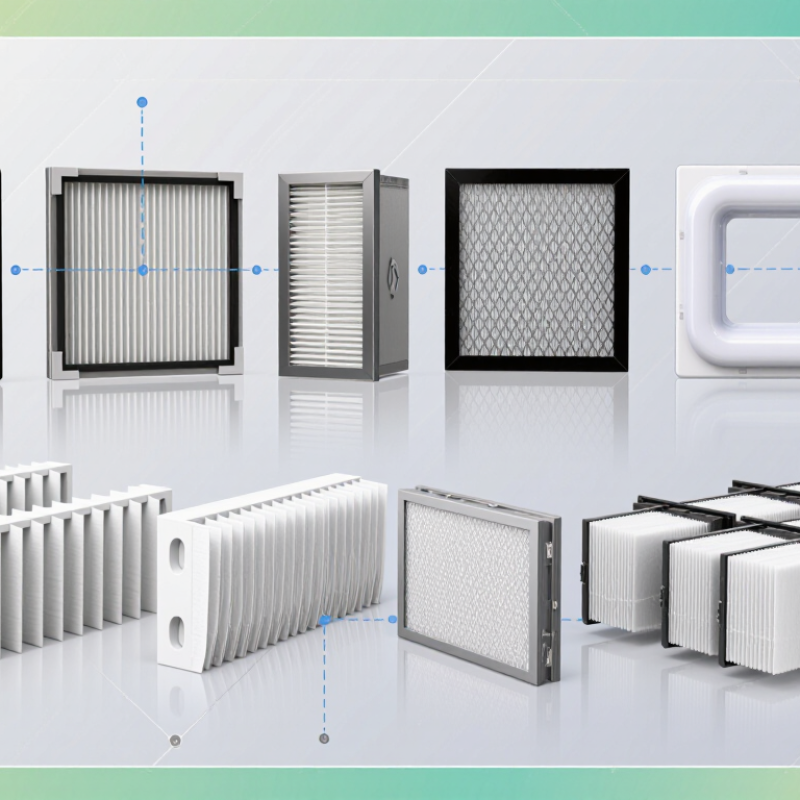
The ten main mini pleated ULPA filter types serve different clean-air requirements. Standard aluminum-frame filters offer low weight and reliable rigidity. Galvanized steel frames suit economical equipment and moderate humidity. Stainless-steel frames resist corrosion in demanding laboratory or process areas. Plastic-frame filters reduce weight and support moisture-sensitive installations. Gasket-seal types use a flat elastomer edge for familiar housing compatibility. Gel-seal types fill small surface irregularities and reduce bypass risk. Knife-edge designs create a tighter interface in terminal housings. High-temperature versions use heat-resistant media and sealants. Chemical-resistant versions need carefully selected adhesives and protective coatings. Compact separatorless filters provide more media area within shallow equipment.
Details matter greatly. A 305-millimeter square filter may fit one housing but fail another. Measure face dimensions, depth, airflow direction, and sealing clearance. Check the rated airflow before comparing efficiency. A filter with lower resistance may reduce fan energy, yet its media area could be smaller. That trade-off deserves testing.
Buyers should request efficiency data under applicable EN 1822 or ISO 29463 methods. Confirm scan-test results, pressure drop, leak-test procedures, and material compatibility. ULPA performance is not determined by appearance alone. I have seen installation errors create more bypass than media defects. That is easy to overlook. Transport protection also matters, especially for long international shipments. Some specifications remain vague, and that should prompt questions, not assumptions. A practical trial in the actual housing can reveal problems that a catalog cannot.
Key Performance Differences Among ULPA Filter Designs
Mini pleated ULPA filters differ most at their most penetrating particle size, or MPPS. Under EN 1822:2019 and ISO 29463, U15, U16, and U17 filters achieve minimum efficiencies of 99.9995%, 99.99995%, and 99.999995%, respectively. These figures describe tested particle removal, not every operating condition. That distinction matters.
A U15 design often balances high capture efficiency with moderate airflow resistance. U16 and U17 models provide tighter filtration, but their denser media can raise pressure drop. The 2024 ASHRAE Handbook identifies airflow resistance, face velocity, sealing, and loading as major factors affecting real HVAC performance. A compact pleat pack may fit a small air handler, yet limited pleat depth can reduce dust-holding capacity. Small is not simple.
Frame construction also changes performance. Seamless gaskets reduce bypass risk, while weak separators may create uneven channels or local turbulence. ISO 29463 testing evaluates the filter element under controlled conditions, but installation errors remain outside that result. Global buyers should compare MPPS efficiency, initial pressure drop, final pressure-drop limits, scan-test records, and seal design. Published catalog values can look precise. They are not always comparable. In practice, a slightly lower-rated filter with stable airflow may outperform a higher-rated filter installed with leakage. That is an uncomfortable point, but it deserves attention.
Top 10 Mini Pleated ULPA Air Filter Types for Global Buyers
Key performance differences among generic ULPA filter designs, shown by minimum rated efficiency at the most penetrating particle size (MPPS).
U15, U16 and U17 represent progressively higher minimum MPPS efficiencies: 99.9995%, 99.99995% and 99.999995%, respectively. Filter media, pleat geometry, sealing method and airflow resistance can vary by design; final selection should also consider pressure drop, face velocity, leakage testing and housing compatibility. Efficiency classifications are aligned with the EN 1822 / ISO 29463 ULPA classification framework.