Top 10 Automatic Feeding Gluing Machines to Buy in 2026
Choosing an Automatic Feeding Gluing Machine in 2026 means comparing more than advertised speed. Feeding accuracy, glue consistency, changeover time, and operator access all affect daily output. A feeder that slips on coated stock can misalign cartons; an uneven glue bead can create rework. Small details matter.
PMMI’s 2024 State of the Industry report examines packaging machinery trends, including manufacturers’ investment in automation amid workforce pressures. That context makes practical performance worth measuring: ask suppliers for tested throughput on your material, glue consumption, setup time, and service response. A brochure’s maximum speed is not a production guarantee. Ask for a demonstration.
Industrial engineer Taiichi Ohno offered a useful principle: “Where there is no standard, there can be no kaizen.” It is not a machine-specific rule, but it highlights why repeatable settings and documented trials matter. This guide compares ten machines through those buyer-focused checks, alongside feeding formats, control features, maintenance needs, and suitability for different workloads. The shortlist is not a verdict. Your own cartons, adhesive, and shift pattern may expose trade-offs that a showroom test misses. That uncertainty deserves attention.
Top 10 Automatic Feeding Gluing Machines to Buy in 2026
How Automatic Feeding Gluing Machines Work
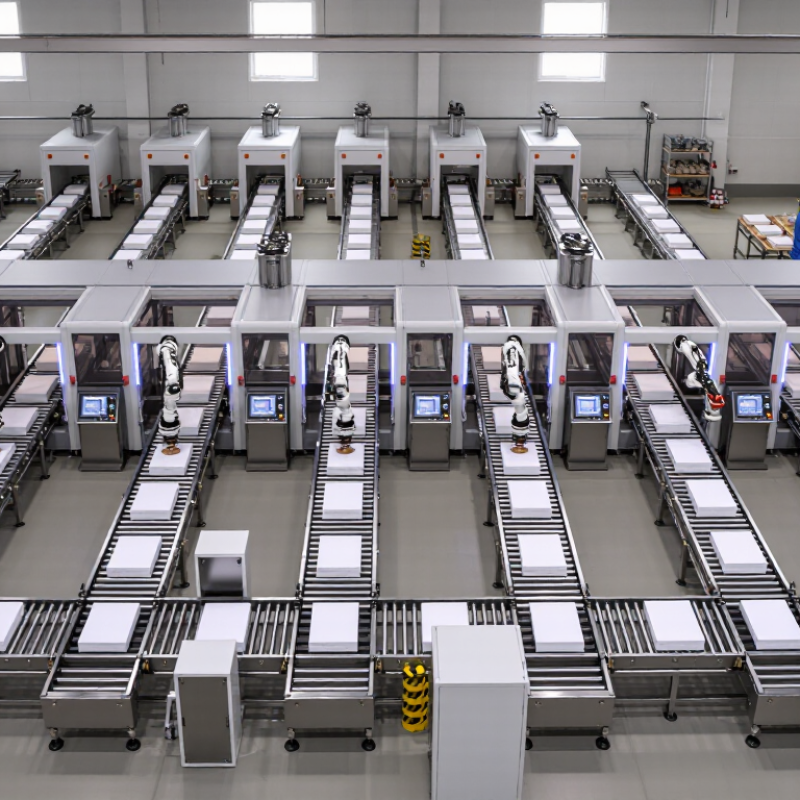
An automatic feeding gluing machine moves flat sheets or components from a stack onto a conveyor. Suction cups or friction belts separate each piece, while sensors check its position. A controller then synchronizes the feed, adhesive applicator, and conveyor speed. Glue may be dispensed as a bead, spray, or roller coating, depending on the material and bond design. Pressure rollers bring the surfaces together. The bonded pieces then move to a holding or curing section.
Small details matter. A skewed sheet can create uneven glue lines or weak corners. Adhesive viscosity, room temperature, feed speed, and nozzle distance all affect results. Fortune Business Insights estimated the global adhesives and sealants market at USD 72.8 billion in 2023, with growth projected to USD 100.2 billion by 2032. That market estimate shows broad demand, but it does not prove that any machine will deliver a specific return. In practice, operators still need to test the actual substrate and adhesive combination.
Key Features to Compare Before Choosing a Machine
Compare feeding stability before headline speed. Ask how the machine handles warped blanks, mixed board thicknesses, and short production runs. Watch a live trial with your own material. Track missed feeds, skew, glue-line width, and jam-clearing time. A fast machine can still create costly rework.
The International Federation of Robotics reported 541,302 industrial robots installed worldwide in 2023, in its World Robotics 2024 report. That figure signals wider factory automation, but it is not a benchmark for gluing-machine performance. Compare usable output, not catalogue speed. Check changeover time, feeder adjustment range, adhesive temperature control, and access to routine cleaning points. Tiny details matter.
Ask for documented acceptance-test results at your intended operating speed. Confirm what the test counts as a defect, and whether performance holds across different operators. Also compare floor space, power needs, guarding, spare-part lead times, and service response. Test it live. A supplier’s best sample may not represent your actual board or adhesive. That gap is easy to overlook. Keep the trial records; they make machine comparisons more reliable.
Top 10 Automatic Feeding Gluing Machines to Buy in 2026
Selecting from the top 10 automatic feeding gluing machines to buy in 2026 means matching machine design to the work, not chasing speed claims. Compare feeder stability, glue-pattern control, changeover time, guarding, and cleaning access. A machine should handle your thinnest and thickest stock without skewing. Ask for trials with your own materials. Small details matter. An uneven bead can create rework across a full shift.
The International Federation of Robotics’ World Robotics 2024 report recorded 541,302 industrial robot installations worldwide in 2023, the second-highest annual total on record. This figure covers industrial robots, not gluing machines specifically, but it reflects continued investment in factory automation. For buyers, the key question is whether feeding, adhesive application, and inspection can work as one stable process. Request measurable acceptance criteria, including feed accuracy, adhesive use per unit, and uptime during a defined production run. A showroom demonstration alone is not enough.
Tips: Bring representative cartons or panels, including warped samples. Check sensor response, nozzle access, spare-part lead times, and operator training. Test it first. Calculate several years of operating costs, too; a lower purchase price may hide adhesive waste or difficult maintenance. A setup that looks perfect on paper may still need adjustment on the factory floor.
Best Machine Types for Different Production Needs
Choosing an automatic feeding gluing machine starts with the material, package shape, and daily workload. Folding-carton lines suit paperboard sleeves, trays, and straight-line boxes. They typically need accurate side registration and steady glue application. Watch a sample run closely: warped blanks can drift, even when the feeder is well adjusted. Small details matter.
For short runs or frequent design changes, a compact folder-gluer with quick-adjust guides can reduce setup time. High-volume plants may prefer a continuous-feed system with a larger hopper and inline inspection. Corrugated packaging often needs wider belts and stronger handling support, while envelope or paper-bag work calls for gentler feeding. Match the machine to the narrowest and widest blanks you actually produce, not only the average size.
Bookbinding and specialty packaging may require a different configuration, such as controlled adhesive placement or multiple glue points. Ask suppliers to test your stock, adhesive, and finished shape before purchase. Record feed stability, glue consistency, changeover time, and rejects during the trial. A fast machine is not always the most productive one. Operator skill still matters, and setup claims can look better on paper than on a busy floor. Allow room for maintenance access and realistic future growth.
What to Check Before Buying and Installing a Machine
Before choosing an automatic feeding gluing machine, match its working range to your actual materials. Check the minimum and maximum sheet or workpiece dimensions, thickness, surface condition, and required glue coverage. A machine that handles your largest panel may still feed narrow pieces poorly. Ask for a trial using your own stock, not just a clean sample supplied for a demonstration. Watch for skewing, glue skips, and buildup around the rollers.
Tips: Confirm the adhesive type and viscosity the machine supports. Ask how feed speed, pressure, and glue quantity are adjusted. Request a written list of utilities, including power, compressed air, and ventilation needs. Measure the machine footprint, then leave room for loading, cleaning, and safe access. Small details matter.
Before installation, check whether the machine can connect smoothly with your existing line. Review infeed and outfeed heights, control signals, operator positions, and planned material flow. Have qualified staff verify site services and safety guarding against the machine’s documentation. Agree on commissioning checks, operator training, cleaning steps, and spare wear parts before delivery. It is easy to focus on speed and overlook cleanup time; that can distort production estimates. Record trial settings and acceptable glue results, even if the first setup needs adjustment.
Top 10 Automatic Feeding Gluing Machines to Buy in 2026
What to Check Before Buying and Installing a Machine
Suggested evaluation weights—not market statistics. Prioritize production fit and glue-process compatibility, then verify installation requirements, safety, service support, and total cost for your facility.
This site uses cookies in order to deliver services in accordance with Privacy Policy. You can use settings within your browser to control the cookies that are set on your computer – conditions of access or storage of cookies.
Your data controller will be LEDOLUX POLAND SP. ul. Innowacyjna 1; 36-060 Głogów Małopolski, which adapts the content of its website to your needs and analyses and examines them to improve it. More information.
This website uses cookies to improve your experience while you navigate through the website. Out of these cookies, the cookies that are categorized as necessary are stored on your browser as they are essential for the working of basic functionalities of the website. We also use third-party cookies that help us analyze and understand how you use this website. These cookies will be stored in your browser only with your consent. You also have the option to opt-out of these cookies. But opting out of some of these cookies may have an effect on your browsing experience.
Necessary cookies are absolutely essential for the website to function properly. This category only includes cookies that ensures basic functionalities and security features of the website. These cookies do not store any personal information.
Any cookies that may not be particularly necessary for the website to function and is used specifically to collect user personal data via analytics, ads, other embedded contents are termed as non-necessary cookies. It is mandatory to procure user consent prior to running these cookies on your website.