

What Are the Top Factory Lighting Types in 2026?
Factory Lighting in 2026 is less about choosing the brightest fixture and more about matching light to the work, building, and operating schedule. A high-bay LED may suit a tall assembly floor, while linear fixtures can provide more even light over benches and production lines. Dust, heat, vibration, ceiling height, and glare matter, too. Small details count.
The U.S. Department of Energy’s 2017 Energy Savings Forecast of Solid-State Lighting projected that broader LED adoption could save 348 terawatt-hours of electricity annually by 2027, compared with a no-LED scenario. That is a national projection, not a factory-specific guarantee. Actual savings depend on existing equipment, controls, operating hours, and maintenance. A lighting audit can reveal where the estimate meets reality.
A practical expert principle, paraphrased from the task-focused approach of lighting scientist Dr. Naomi Miller of Pacific Northwest National Laboratory, is this: design for the visual task and actual conditions, not just the fixture label. Treat that as a guide, not a direct quotation. This article compares LED high bays, linear industrial fixtures, task lights, hazardous-location luminaires, and connected controls. It will consider visibility, energy use, durability, and installation constraints. Not every factory needs every technology. And “smart” is not automatically better. The right Factory Lighting plan should make fine details visible at a workbench, reduce harsh shadows across a line, and remain practical to maintain.
How Factory Lighting Supports Industrial Workspaces
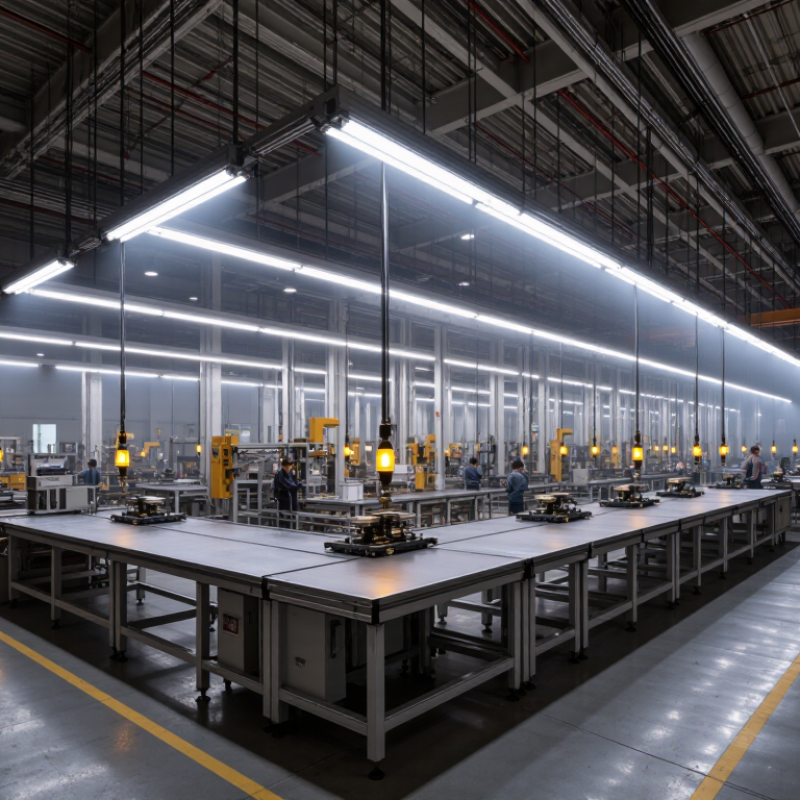
Factory lighting does more than brighten a floor; it shapes visibility, comfort, and daily work rhythms. In 2026, LED high-bay fixtures remain a practical option for tall production areas and warehouses. Their directed light can reach aisles, machine zones, and loading points. Good layout matters. Fixture rows should limit dark gaps and harsh glare, especially where workers read labels, check gauges, or handle moving parts. Linear fixtures often suit assembly lines, while adjustable task lights support close inspection at workbenches. Consistent light and suitable color rendering can help workers spot surface defects, though lighting cannot replace proper inspection procedures.
Lighting also affects fatigue and safety during long shifts. Flicker, deep shadows, and reflections on polished metal can make routine tasks harder than expected. Small details count. Occupancy sensors and daylight controls may reduce wasted energy in suitable spaces, but settings need testing around changing shifts and equipment. Dust, heat, vibration, and moisture can influence fixture selection and maintenance schedules. Check manufacturer specifications and consult a qualified lighting professional when planning an installation. There is no perfect layout for every factory; even a careful design may reveal dim corners after machines and storage racks are in place. Regular on-site reviews help identify those missed areas.
What Are the Top Factory Lighting Types in 2026? — How Factory Lighting Supports Industrial Workspaces
| Lighting Type | Typical Factory Application | Indicative Illuminance | Typical System Efficacy | Typical Rated Life | Main Advantages | Selection Considerations |
|---|---|---|---|---|---|---|
| LED High-Bay | Production floors, warehouses, and other spaces with high ceilings | 200–500 lux, depending on the task | 130–190 lm/W | 50,000–100,000 hours | Efficient, long-lasting, and available with optics suited to different mounting heights | Check glare control, ceiling height, beam distribution, and heat management |
| LED Linear High-Bay | Long production lines, assembly areas, and aisles with continuous rows | 200–500 lux, depending on the task | 130–190 lm/W | 50,000–100,000 hours | Provides even, elongated light distribution and can reduce dark gaps between fixtures | Match fixture length and spacing to workstations, racks, and aisle layout |
| LED Low-Bay | Workshops, service areas, and factory rooms with lower ceilings | 150–500 lux, depending on the task | 120–180 lm/W | 50,000–100,000 hours | Designed for shorter mounting heights and can provide controlled, uniform illumination | Choose a distribution that limits glare and prevents overly bright patches |
| LED Task Lighting | Inspection benches, machine stations, fine assembly, and detailed work | 500–1,000 lux at the task area | 100–170 lm/W | 30,000–70,000 hours | Directs light where precision work is performed and can complement general lighting | Position carefully to avoid shadows, reflections, and glare; use appropriate color rendering |
| LED Vapor-Tight Lighting | Washdown zones, food-processing support areas, and dusty or damp spaces | 150–500 lux, depending on the task | 110–170 lm/W | 50,000–100,000 hours | Sealed construction helps protect against moisture, dust, and routine cleaning exposure | Verify ingress-protection rating, chemical compatibility, and cleaning requirements |
| Hazardous-Location Lighting | Areas where flammable gases, vapors, or combustible dust may be present | 200–500 lux, as required by the task and safety plan | 100–160 lm/W | 50,000–100,000 hours | Purpose-built equipment can be certified for specified hazardous-area classifications | Confirm the area classification and applicable local codes before specifying equipment |
| Daylight-Linked LED Lighting | Perimeter production zones and workspaces with useful daylight access | Designed to maintain the task's target illuminance | Depends on the LED fixture and control system | Depends on the fixture; commonly 50,000 hours or more | Photosensors can dim electric lighting when daylight is sufficient, reducing energy use | Commission sensors to prevent unwanted dimming or changes in light levels at workstations |
Note: Figures are indicative ranges, not guaranteed specifications. Actual performance and service life depend on the fixture, operating temperature, controls, maintenance, and installation. Illuminance targets should be selected for the specific task and applicable workplace standards.
Related Posts
-
Advantages of Embracing LED Lighting for Sustainable Procurement
-
7 Essential Tips to Boost Energy Efficiency with LED Lighting
-
How to Choose the Best LED Lighting for Your Home or Office Needs
-
2026 Top LED Lighting Trends for Global Buyers to Consider?
-
Ultimate Guide to Selecting the Best LED Luminaires: Insights from Industry Trends and Data
-
Exploring the Advantages of Led Lighting in Energy Efficiency and Cost Savings for Modern Businesses