

China’s FRP rectangular tube market serves construction, infrastructure, electrical, and industrial projects. The wider composites sector offers useful context, though it does not measure rectangular tubes alone. MarketsandMarkets’ 2024 Composites Market report estimates the global market at USD 94.7 billion, with projected growth through 2029. That is a broad signal, not proof that every supplier can deliver consistent profiles.
A reliable supplier comparison should go beyond polished catalogs. Check resin type, fiber orientation, dimensional tolerances, surface finish, and documented test methods. Ask for recent production samples. Inspect cut edges for voids and uneven reinforcement. Request evidence of load testing and quality control, then compare lead times, customization options, and export packaging. Small details matter. A low quotation can hide costly variation.
Lucintel CEO Sanjay Mazumdar’s published market commentary emphasizes balancing composite performance with cost; this is a paraphrase, not a verified verbatim quotation. That trade-off is central when choosing a Frp Rectangular Tube supplier. The strongest shortlist will connect specifications to the real load, environment, and installation method. It should also include traceable technical documents and clear answers from engineering staff. One caveat remains: supplier claims require independent checking. This guide compares leading Chinese manufacturers using practical criteria, while recognizing that public data may not reveal factory-level consistency. Reconfirm certifications, sample quality, and current capacity before placing an order.
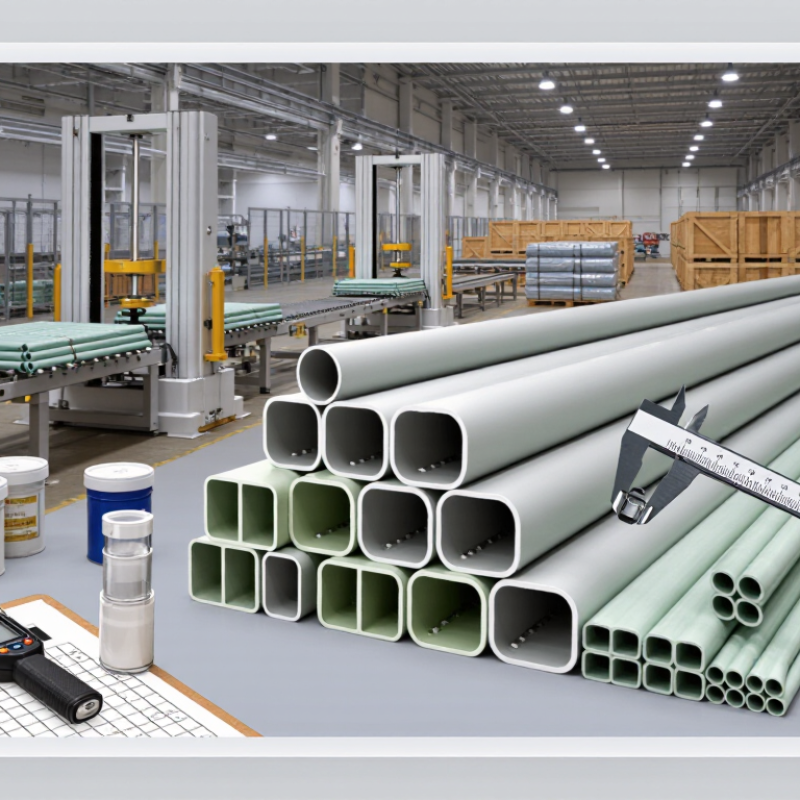
Chinese FRP rectangular tube suppliers differ less by catalog size than by process control. Pultrusion pulls continuous glass rovings through a resin bath and heated die, creating profiles with fibers aligned along the tube. That helps deliver consistent lengthwise strength, but corners and cut ends still need close inspection. Small voids matter. Ask suppliers for glass content, wall-thickness tolerances, and batch test records—not only a tensile-strength headline.
Resin choice should match exposure. Isophthalic polyester is common for general outdoor use; vinyl ester can offer better chemical resistance, while epoxy is often selected for demanding performance needs. The ACI 440.1R-15 design guide reports GFRP reinforcement densities of about 1.25–2.1 g/cm³, far below steel’s roughly 7.9 g/cm³. This is a useful material benchmark, not a guaranteed tube value. For a supplier comparison, request resin-system details, UV and water-exposure data, and test results for the actual rectangular section. A brochure can look convincing. It may still leave the corner strength unclear.
When comparing FRP rectangular tube suppliers in China, treat 1.8–2.0 g/cm³ as a typical density range, not a universal pass-or-fail limit. Pultruded tubes in this range often combine glass reinforcement with a thermoset resin, but the exact value depends on the formulation and profile. Density is useful, but incomplete. It cannot confirm straightness, wall consistency, or strength on its own. Ask for the measurement method, sample size, and batch records alongside the quoted figure.
Use ASTM D3917 as a reference for dimensional tolerances of pultruded FRP shapes. The applicable limits depend on the profile and measured dimension, so request the supplier’s tolerance table rather than assuming one number covers every tube. Check outside width and height, wall thickness, squareness, and straightness on actual samples. A simple caliper reading at one point may miss variation along a long section. That matters. Compare inspection results with the agreed drawing and keep the data tied to the production lot. A careful supplier should explain any deviations clearly; still, paperwork is not a substitute for inspecting received stock.
Core quality data for evaluating pultruded FRP rectangular tubes
The 1.8–2.0 g/cm³ values show a typical reference range, not measurements from specific suppliers. ASTM D3917 dimensional tolerances depend on the profile and its dimensions; confirm applicable requirements against the relevant standard and product drawing.
When comparing FRP rectangular tube suppliers, request paired ASTM D638 tensile and ASTM D790 flexural results for the same product grade. ASTM International’s D638 and D790 methods define how plastics are tested; they do not set universal strength values. A credible supplier report should show measured results, specimen direction, dimensions, conditioning, and test speed. This matters because pultruded tubes can be much stronger along the fibers than across them.
Compare the actual numbers, not just “high strength” claims. Check tensile strength and modulus under D638, then flexural strength and modulus under D790. Ask whether samples came from the tube wall or a separately molded coupon. That distinction can change the comparison. Request multiple specimens and the average, plus the lowest result. A single impressive figure is thin evidence. Public industry reports rarely provide directly comparable tube-by-tube datasets, so treat supplier-specific laboratory reports as primary evidence, not as a universal market ranking.
Tips: Match wall thickness and fiber orientation before comparing quotes. Check whether reports identify the testing laboratory and report date. If one supplier shares only a brochure value, ask for the underlying test report. Small inconsistencies in conditioning or specimen preparation are easy to overlook, and they deserve a second look.
Supplier-specific ASTM D638 and ASTM D790 results are not included because no verifiable test reports or source data were provided. The entries below are an evidence-based comparison template; request the corresponding reports before comparing suppliers.
| Comparison item | Supplier A | Supplier B | Supplier C | Supplier D |
|---|---|---|---|---|
| Supplier identity | Not disclosed | Not disclosed | Not disclosed | Not disclosed |
| ASTM D638 tensile strength | Not verified; request report | Not verified; request report | Not verified; request report | Not verified; request report |
| ASTM D638 tensile modulus | Not verified; request report | Not verified; request report | Not verified; request report | Not verified; request report |
| ASTM D790 flexural strength | Not verified; request report | Not verified; request report | Not verified; request report | Not verified; request report |
| ASTM D790 flexural modulus | Not verified; request report | Not verified; request report | Not verified; request report | Not verified; request report |
| Test report details to confirm | Laboratory, date, specimen, orientation, conditioning, and test results | Laboratory, date, specimen, orientation, conditioning, and test results | Laboratory, date, specimen, orientation, conditioning, and test results | Laboratory, date, specimen, orientation, conditioning, and test results |
| Comparison status | Insufficient verified data to rank | Insufficient verified data to rank | Insufficient verified data to rank | Insufficient verified data to rank |
ASTM D638 is a tensile test method for plastics, and ASTM D790 is a flexural test method for plastics. For FRP rectangular tubes, confirm that the reported specimen represents the product, including fiber orientation, wall section, laminate or pultrusion direction, and conditioning. Do not treat results from different specimen preparations or test conditions as directly comparable.
When comparing Chinese FRP rectangular tube suppliers, check more than catalogue breadth. Ask whether they offer pultruded tubes in different resin systems, glass-fiber contents, wall thicknesses, and custom lengths. MarketsandMarkets’ Pultrusion Market report projected growth from USD 2.3 billion in 2022 to USD 3.2 billion by 2027, a 6.7% compound annual growth rate. This is market context, not proof of any supplier’s output. Details matter.
Verify certificates by scope and issuing body, then match them to the actual factory and product. Request test reports for dimensions, tensile strength, flexural performance, and water absorption. Compare annual capacity with recent production records and lead times; a large stated capacity alone proves little. Ask for export-market references, packaging photos, and sample shipping documents with confidential details removed. These checks help assess whether tubes can arrive undamaged and consistently sized. Numbers need context. A supplier may have broad product options but limited testing or export experience, and that trade-off is easy to miss.
When comparing FRP rectangular tube suppliers in China, start with documented quality controls. Ask for a current ISO 9001 certificate and confirm its scope covers the manufacturing site and relevant processes. A certificate is useful, but it does not verify every tube. Request recent test reports linked to the product type or production batch. Check the test date, methods, measured properties, and specimen details. Small details matter. A report with no traceable sample information is hard to assess.
Confirm dimensions in writing, including wall thickness, corner radius, length, and permitted tolerances. For a real comparison, request a sample and measure it at several points; a single reading can miss variation. Then share the intended span, support positions, load direction, and service conditions with the supplier. Ask for the assumptions behind any load design, such as material properties and safety factors. Numbers need context. A tube suited to a short indoor frame may not perform the same way outdoors or under repeated loading. Records may still leave gaps, so clarify who reviews design changes and how deviations are documented before production.
TERMS OF USE - LEDOLUX
This site uses cookies in order to deliver services in accordance with Privacy Policy. You can use settings within your browser to control the cookies that are set on your computer – conditions of access or storage of cookies.
Your data controller will be LEDOLUX POLAND SP. ul. Innowacyjna 1; 36-060 Głogów Małopolski, which adapts the content of its website to your needs and analyses and examines them to improve it. More information.