

In 2026, choosing a Hepa Air Filter means looking beyond a bold label on a product box. A compact purifier beside a child’s bed has different needs from a whole-home system handling dust across several rooms. Filter grade, airflow, room size, replacement cost, and noise all shape the real-world result. Small print matters. A high-efficiency filter can still disappoint if the device is poorly matched to the space.
Indoor-air researcher Dr. Richard Shaughnessy’s work offers a useful reminder: evaluate filtration alongside airflow and the room where the cleaner will operate. This is a paraphrased takeaway, not a direct quotation. It helps explain why “True HEPA,” H13, and H14 filters should not be compared by grade alone. Fit and performance matter.
This guide examines the leading Air Filter Hepa types, including portable purifier filters, HVAC-compatible options, and models paired with activated carbon. It will explain where each type may work well, what its limits are, and which specifications deserve a closer look. Some claims sound cleaner than the air itself. For example, washable filters may seem convenient, but they are not automatically equivalent to certified HEPA media. The best choice depends on your room, your system, and the maintenance you can realistically keep up with. Expect practical trade-offs, not a single winner for every home.
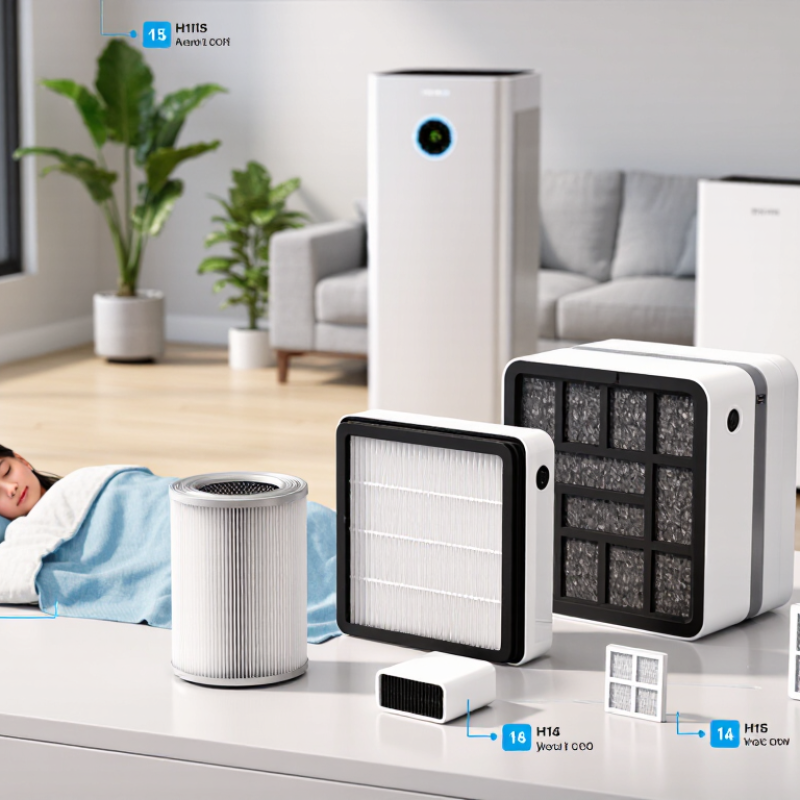
In 2026, HEPA describes filtration performance, not a promise that every purifier cleans a room equally well. The U.S. Environmental Protection Agency’s Guide to Air Cleaners in the Home says HEPA filters capture at least 99.97% of particles at 0.3 micrometers. This size is used for testing because it is especially difficult to capture. Smaller or larger particles may also be trapped, but the headline percentage alone cannot predict real-world results.
Standards differ across regions. Under EN 1822-1, European H13 filters are rated at least 99.95% efficient at the most penetrating particle size; H14 reaches 99.995%. That detail matters. A filter’s frame seal, installation, and airflow also affect performance. A small gap can let unfiltered air bypass the media, while dense media may restrict airflow if the unit is poorly matched. The numbers are useful, but they are not the whole story.
Tips: Check the named test standard and filter class. Look for a sealed fit and airflow data, too. Ask how the device performs at its normal operating speed, not only its highest setting. Be skeptical of vague “HEPA-type” wording; it may not indicate tested HEPA performance.
HEPA grades describe tested particle-capture performance, not simply how “strong” a filter sounds. Under the European EN 1822 standard, H13 filters achieve at least 99.95% efficiency at the most penetrating particle size, or MPPS; H14 reaches 99.995%. The MPPS varies by filter, so these figures are not a promise of identical performance for every particle size. Small distinction. It matters.
The U.S. Environmental Protection Agency’s Guide to Air Cleaners in the Home gives a different benchmark: HEPA filters capture at least 99.97% of particles measuring 0.3 microns under test conditions. That figure should not be compared directly with H13 or H14 results, because the test methods and particle-size basis differ. A label alone tells only part of the story. Leaks around a filter, poor installation, or weak airflow can reduce real-world results; a spotless test chamber is not a living room. Also, MERV ratings belong to a separate rating system and do not translate directly into HEPA grades. Check the standard cited on the filter documentation, plus the device’s fit and airflow specifications.
The main HEPA filter types differ by tested efficiency and construction. In the United States, the U.S. Environmental Protection Agency describes HEPA filtration as capturing at least 99.97% of particles 0.3 microns in size. That benchmark applies to the filter, not automatically to an entire purifier or room. Air can bypass a poorly sealed filter.
European EN 1822 classifies high-efficiency filters by performance at their most penetrating particle size. H13 filters must capture at least 99.95%; H14 filters, at least 99.995%. These grades are common in technical specifications. Higher efficiency can also mean greater airflow resistance, so the system must be designed to accommodate it. A number alone is not enough.
Construction matters, too. Most HEPA filters use pleated fibrous media, often glass microfibers, to increase filtering area in a compact frame. Mini-pleat designs pack more surface area into a smaller depth; panel and deep-bed designs suit different airflow needs. “HEPA-type” or “HEPA-like” labels may not meet the same tested standard. Check the test. I’d also look for clear performance data and a well-sealed housing; choosing by grade alone is an easy mistake.
| Filter Type | How It Is Defined | Efficiency Reference | Common Applications | Key Considerations |
|---|---|---|---|---|
| H13 HEPA | A high-efficiency grade classified under the EN 1822 standard, with performance assessed at the most penetrating particle size (MPPS). | At least 99.95% overall efficiency at MPPS under EN 1822. | Air purifiers, healthcare spaces, laboratories, and ventilation systems where high particle filtration is required. | Check that the complete filter assembly is tested and properly sealed; leakage around the filter can reduce system performance. |
| H14 HEPA | A higher EN 1822 filter grade than H13, tested at the MPPS. | At least 99.995% overall efficiency at MPPS under EN 1822. | Cleanrooms, specialized healthcare settings, laboratories, and other applications with demanding filtration requirements. | Higher-grade media can increase airflow resistance. The fan and system must be designed to maintain the required airflow. |
| U.S.-rated HEPA | A HEPA filter meeting the commonly used U.S. definition for removing particles from air. | At least 99.97% efficiency at 0.3 micrometers under the commonly cited U.S. definition. | Portable room air cleaners, vacuum cleaners, and filtration equipment. | This rating uses a specific particle-size reference and is not directly interchangeable with EN 1822 H13 or H14 grades. |
| Mini-pleat HEPA | A pleated filter design with closely spaced folds, often supported by separators or hot-melt beads to maintain pleat spacing. | Efficiency depends on the certified grade and test standard; the construction itself does not determine the rating. | Compact air-cleaning units, cleanroom terminal filters, and systems where filter depth is limited. | Its compact profile can provide a large media area, but the frame, seal, airflow, and certified grade still matter. |
| Deep-pleat HEPA | A deeper pleated-media design that commonly uses separators to keep pleats apart and support airflow through the media. | Available in different grades; performance should be verified against the stated test standard and grade. | Air-handling units, industrial systems, laboratories, and other installations with space for a deeper filter. | Confirm that the housing can accommodate the filter depth and that the gasket forms an effective seal. |
| “HEPA-type” or HEPA-style filter | A marketing description that does not, by itself, confirm compliance with a recognized HEPA test standard or grade. | No universal efficiency threshold is implied by the wording alone. | Some consumer appliances and replacement-filter products. | Look for a stated test method, efficiency rating, and independent or manufacturer test documentation before treating it as a certified HEPA filter. |
| Washable or reusable filter labeled HEPA | A filter promoted as washable or reusable; washing may affect the media and does not establish HEPA performance. | Performance depends on the specific product and validated testing; the label alone is not proof of a HEPA grade. | Some reusable consumer filtration products. | Follow the manufacturer’s care instructions and verify that the filter retains its stated performance after cleaning and reuse. |
HEPA filter designs are shaped by airflow, available space, and the particles a system must capture. In portable air cleaners, deep pleated panels provide substantial media area without taking up much room. Their folds look simple, but uneven spacing can restrict airflow. A tight seal around the frame matters too; air can bypass the media through small gaps.
Compact mini-pleat filters suit equipment where depth is limited, such as ceiling units or clean work areas. Larger HVAC systems often use rigid panels that are easier to install and replace. High-grade filters, including H13 and H14 classifications, may be selected for demanding environments, but the grade alone does not guarantee good performance. The fan must handle the filter’s resistance, and the housing must fit correctly. Not every setting needs the highest grade.
Some industrial systems use cylindrical or specialized HEPA modules to fit narrow ducts or capture particles near a process. In homes, a well-sealed portable unit may be more practical than adapting a whole ventilation system. Check the stated test standard, dimensions, and airflow requirements before comparing filters. A neat specification can still mislead. It is easy to focus on efficiency and overlook replacement access, noise, or the cost of reduced airflow.
Minimum overall particle-capture efficiency by EN 1822 filter class, measured at the most penetrating particle size (MPPS).
How designs serve different applications: E10–E12 filters can suit general ventilation and less demanding air-cleaning needs; H13 is commonly selected for healthcare and controlled environments; H14 is used where more stringent particle control is required, such as critical pharmaceutical processes. Pleat geometry, airflow, pressure drop, housing seals, and the system’s validated requirements also affect suitability.
Chart classes and minimum efficiencies are based on EN 1822. The horizontal axis starts at 80%; actual selection should follow the application’s requirements and applicable standards.
Comparing HEPA filter types starts with the job they must do. A portable purifier, a central HVAC system, and a vacuum need different shapes and airflow capacities. Check the filter’s stated efficiency and the testing standard behind it. H13 and H14 labels, for example, refer to classifications under particular standards; labels alone do not prove that a filter fits your device or seals properly.
Fit matters. Gaps around a filter can let air bypass the media, reducing practical performance. Compare airflow and pressure drop, too: a dense filter may capture fine particles effectively but restrict airflow in a system not designed for it.
For room purifiers, consider clean-air delivery rate and room size, rather than choosing by filter class alone. Noise matters too. A unit that sounds like a desk fan on its highest setting may be left on low. Check replacement intervals, filter availability, and costs, since dust loading and household conditions can change how often a filter needs attention.
One detail is easy to overlook: published test results may not reflect real-world fit or use, so the product’s compatibility instructions deserve a careful read.
TERMS OF USE - LEDOLUX
This site uses cookies in order to deliver services in accordance with Privacy Policy. You can use settings within your browser to control the cookies that are set on your computer – conditions of access or storage of cookies.
Your data controller will be LEDOLUX POLAND SP. ul. Innowacyjna 1; 36-060 Głogów Małopolski, which adapts the content of its website to your needs and analyses and examines them to improve it. More information.