

What Are the Top Machinery Gasket Types in 2026?
Machinery Gasket selection in 2026 is less about choosing a popular material and more about matching the seal to the joint. Temperature, pressure, media, flange finish, and bolt load all matter. A gasket that performs well on a cool water line may fail beside a vibrating pump or hot exhaust manifold. Small details count.
Grand View Research estimated the global industrial gasket market at approximately US$11.4 billion in 2023 and projected continued growth through 2030. This broad market estimate signals sustained demand, but it does not rank individual gasket types. For practical selection, engineers still compare operating conditions and applicable specifications, including ASME B16.20 for metallic gaskets and ASME B16.21 for nonmetallic flat gaskets. Standards and manufacturer data sheets should be checked against the actual application.
Bolted-joint authority John H. Bickford’s published work emphasizes the importance of controlled bolt preload to joint reliability. That principle is central: even a suitable gasket can leak when compression is uneven. No material fixes poor assembly.
This guide examines the leading machinery gasket types used across pumps, engines, compressors, and industrial piping in 2026. It compares spiral-wound, sheet, elastomeric, metal-jacketed, and other common designs by their strengths and limits. The “top” choice depends on service conditions, not a universal ranking. Where published data cannot establish a clear winner, that uncertainty deserves attention—not a confident guess.
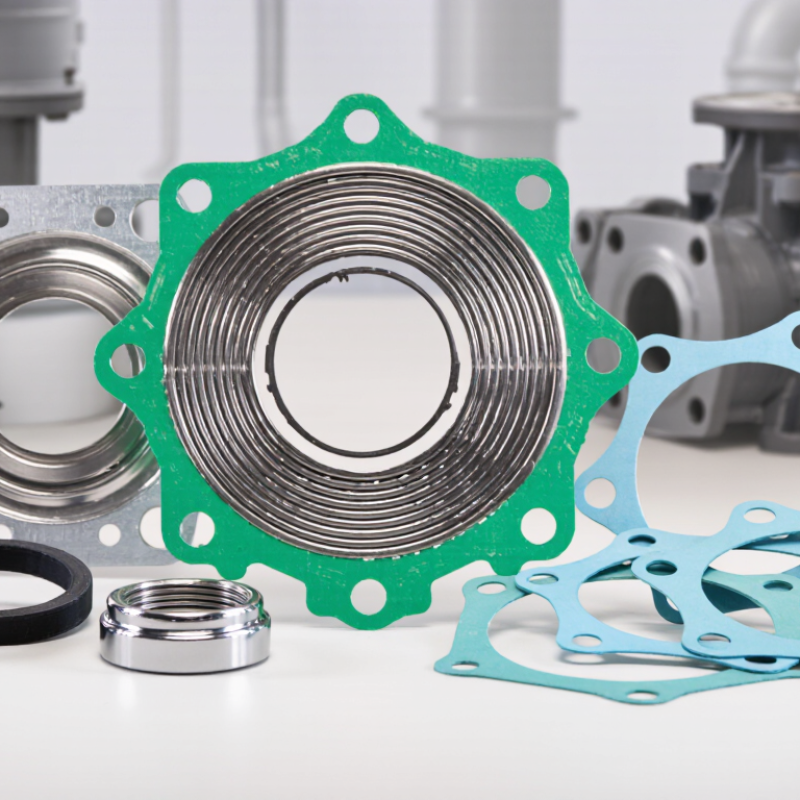
How Machinery Gaskets Seal: Compression, Recovery, and Leakage Paths
What Are the Top Machinery Gasket Types in 2026?
How Machinery Gaskets Seal: Compression, Recovery, and Leakage Paths
A gasket seals when bolted flanges compress it enough to fill surface scratches and small gaps. The material must also recover when loads or temperatures shift. Too little compression leaves open channels; too much can crush the gasket and weaken its seal. ASTM International’s F36 test method measures gasket compressibility and recovery, useful properties when comparing materials. But a lab result cannot fully predict a real joint.
Leakage often follows a connected path across flange faces, around bolt holes, or through damaged gasket material. Surface finish, uneven bolt loading, vibration, and thermal cycling can all widen that path. The U.S. Department of Energy’s Improving Compressed Air System Performance sourcebook estimates that leaks can waste 20–30% of compressor output in typical systems. That figure covers system leaks, not gaskets alone. Still, it shows why a small hiss near a joint deserves attention. A tidy torque calculation may miss uneven contact.
Tips: Check flange faces for scratches and residue before installation. Tighten bolts in a controlled sequence, and inspect joints after startup. Record the material, temperature, and leakage observations. Real conditions are messier than a test bench, and one inspection may not reveal every leak path.
What Are the Top Machinery Gasket Types in 2026? — How Machinery Gaskets Seal: Compression, Recovery, and Leakage Paths
| Gasket type | Typical construction | How it seals | Compression and recovery | Leakage paths it helps control | Common machinery uses | Selection considerations |
|---|---|---|---|---|---|---|
| Compressed non-asbestos fiber sheet | Compressed fiber, fillers, and elastomer binder formed into sheet material. | Compresses into flange-face irregularities to create a continuous sealing contact area. | Usually needs sufficient initial bolt load; recovery is limited compared with elastomeric materials. | Helps block paths across surface scratches, waviness, and small face imperfections. | Pumps, compressors, gearboxes, pipe flanges, and general-purpose equipment. | Check the fluid, temperature, pressure, flange finish, and required bolt load against the material specification. |
| Flexible graphite | Expanded graphite sheet or graphite sealing layers, sometimes reinforced with metal insert or tanged reinforcement. | Flows into surface texture under compression; suitable grades can maintain sealing performance through thermal cycling. | Compressible, with useful resilience depending on construction and reinforcement; can be sensitive to handling damage. | Seals face irregularities and can reduce leakage along the flange interface when properly compressed. | Hot equipment, exhaust connections, heat exchangers, valves, and selected process-fluid joints. | Verify oxidation limits, fluid compatibility, reinforcement, pressure conditions, and installation requirements. |
| PTFE gasket | Skived or expanded PTFE sheet, or a PTFE envelope around a compliant core. | Conforms to flange surfaces and provides broad chemical resistance across many services. | PTFE can creep or relax under sustained load; expanded or filled grades are designed to improve dimensional stability. | Fills minor surface paths at the joint, but long-term sealing depends on managing stress relaxation and bolt load. | Chemical-processing pumps, pipework, mixers, and equipment handling corrosive fluids. | Check grade-specific creep behavior, temperature and pressure limits, permeation needs, and compatibility with the fluid. |
| Elastomeric gasket | Molded or cut rubber-like materials, such as EPDM, NBR, or FKM, selected for the service. | Elastic deformation creates contact pressure against mating surfaces, often at relatively low seating loads. | Typically offers strong elastic recovery, though heat, aging, compression set, and fluid exposure can reduce it. | Blocks interface paths when the seal is correctly sized and compressed; the profile can also seal around ports or covers. | Water pumps, housings, access covers, low-pressure connections, and fluid-handling machinery. | Choose the elastomer by fluid compatibility, operating temperature, pressure, hardness, and expected exposure or aging. |
| Spiral-wound gasket | Alternating spirals of formed metal and a soft filler, commonly with inner or outer rings depending on design. | The winding provides a spring-like structure while the filler conforms to flange faces under compression. | Can accommodate some movement and thermal cycling; performance depends on correct compression and suitable flange design. | Provides a tortuous sealing path across the flange interface; rings help control compression and positioning in applicable designs. | Pressure vessels, heat exchangers, steam systems, and process piping on suitable flanges. | Match the winding, filler, rings, flange geometry, bolt load, and service conditions to the joint specification. |
| Metal ring-joint gasket | Solid metal ring with a defined cross-section that seats in matching machined grooves. | High localized contact stress at the ring and groove creates the seal when the joint is correctly assembled. | Little elastic recovery after seating; relies on precise geometry, sound surfaces, and adequate assembly load. | Seals at the narrow metal-to-metal contact region rather than across a broad sheet-gasket area. | Selected high-pressure flanged connections and specialized industrial equipment. | Requires compatible groove and ring dimensions, material suitability, careful inspection, and controlled assembly. |
| Camprofile (kammprofile) gasket | Metal core with concentric serrations, commonly covered by a soft sealing layer. | Serrations concentrate load while the facing material conforms to the flange surface. | Metal core provides stability; the facing supplies local conformity. Recovery varies with facing material and construction. | Limits leakage across the joint by combining concentrated contact at the serrations with a conformable surface layer. | Heat exchangers, flanged machinery connections, and applications requiring a robust semi-metallic design. | Check facing compatibility, flange condition, required seating stress, and whether the joint permits this gasket style. |
Note: These are common gasket families, not a universal ranking. Actual sealing performance depends on the specific grade and construction, flange condition, bolt load, installation, fluid, temperature, and pressure. Consult the applicable equipment and gasket specifications before selection.