What Are the Top Types of Exterior Downlights?
Exterior lighting does more than brighten a doorway. It helps reveal steps, define a porch, and make a home easier to navigate after sunset. Choosing the right Exterior Downlight, however, takes more than picking a bright bulb. Fixture style, beam direction, weather exposure, and installation location all affect the result.
Energy efficiency is part of the decision. The U.S. Department of Energy’s Energy Saver guidance reports that LED lighting uses at least 75% less energy and can last up to 25 times longer than incandescent lighting. These figures describe LEDs broadly, not every exterior downlight in every installation. Actual performance depends on the product, controls, and use. A careful comparison matters.
There is no universal best fixture. Recessed soffit downlights can give covered entries a clean, low-profile look, while surface-mounted models may suit ceilings that cannot accommodate recessed housings. Adjustable gimbal lights can direct a beam toward a wall or pathway. Step and wall-recessed lights serve closer, lower-level guidance. Small details count. A narrow beam may create sharp highlights, while a wider beam can soften the scene. Glare can still be a problem.
This guide compares the main types of exterior downlights, their typical uses, and the practical trade-offs homeowners should consider. It also looks at weather ratings, light color, and placement. Those details are easy to overlook. A fixture that looks ideal in a catalog may feel too harsh above a real front door.
What Defines an Exterior Downlight? Recessed, Surface, and Adjustable Types
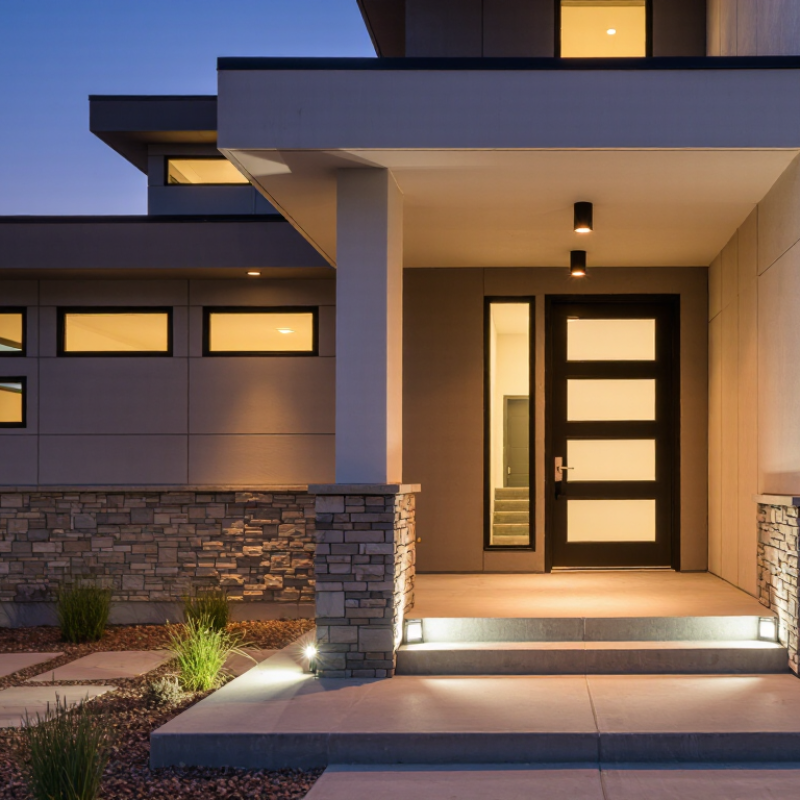
An exterior downlight directs light downward from a ceiling, soffit, or covered entry.
It can help people find a doorway, read a house number, or see the edge of a step. The housing and seals should suit the fixture’s actual exposure to rain and humidity. Check the product’s outdoor rating. Placement matters, too: even a suitable fixture can create glare when aimed toward a window or approaching visitor.
Recessed downlights sit inside a ceiling cutout, keeping the surface clean and low-profile. They work well in deep soffits, but require enough cavity space and careful sealing around the opening.
Surface-mounted types attach beneath the ceiling, making them useful where there is little room above it. They are easier to inspect, though the visible body may look bulky on a narrow porch. Small trade-off.
Adjustable downlights pivot toward a wall, planter, or entry sign. This flexibility helps when the target changes, but a poorly aimed beam can shine into eyes or windows. Check beam spread and mounting height before choosing; a narrow beam may create a bright spot with dark edges. For paths, several softer pools can feel more comfortable than one intense circle. Even a measured layout may need a small aiming adjustment after dusk.
Which Exterior Downlights Suit Eaves, Patios, Paths, and Facades?
Exterior downlights work best when their beam matches the space. Recessed fittings suit eaves, where a clean ceiling line matters. Choose a suitable weather rating for the area’s exposure to rain and moisture. Under a sheltered patio roof, warm-white light can make seating feel comfortable without flattening the scene. A dimmer helps when bright task lighting is not always needed.
For paths, downlights set into an overhang can mark a route, but avoid placing them where they shine into people’s eyes. Keep spacing even and check the effect after dark; drawings rarely show every shadow. Adjustable downlights can highlight a facade feature, while wider-beam fittings spread light more softly across a broad wall. One common misstep is using narrow beams everywhere. The result can look patchy. For exposed locations, choose fittings and installation methods suited to the conditions, and have a qualified electrician check wiring and placement. Visibility matters, but so does glare.
How Do IP Ratings Compare? IEC 60529: IP44 Splash, IP65 Jets, IP67 Immersion
Exterior downlights are commonly recessed into soffits or mounted on walls beneath eaves. Their IP rating describes protection against solid objects and water, not brightness or overall durability. Under IEC 60529, the first digit covers solids and the second covers water. IP44 guards against objects larger than 1 mm and splashing water from any direction. It can suit a sheltered porch, but wind-driven rain may call for more protection.
IP65 is dust-tight and tested against water jets, making it a stronger choice for exposed walls or areas that get regular rinsing. IP67 is also dust-tight and can withstand temporary immersion, typically up to 1 metre for 30 minutes under test conditions. That does not make a fitting suitable for permanent submersion. A rating also says little about corrosion, UV exposure, or whether the fitting will stay sealed after poor installation. Those details matter outdoors.
Tips: Match the rating to the fitting’s actual location, then check its installation instructions. Look at the gasket and cable entry, too. A high rating is reassuring, but a pinched seal can still let water in. It’s an easy detail to overlook.
What Are the Top Types of Exterior Downlights? - How Do IP Ratings Compare? IEC 60529: IP44 Splash, IP65 Jets, IP67 Immersion
| Exterior Downlight Type |
Typical Installation |
Common Applications |
IP Rating to Consider |
Selection Notes |
| Recessed downlight |
Set into a soffit, porch ceiling, or covered outdoor ceiling |
Covered entrances, verandas, and sheltered patios |
IP44 or higher, as exposure requires |
Check ceiling depth, insulation clearance, and whether the fitting is rated for the actual exposure and installation position. |
| Surface-mounted downlight |
Fixed directly to a ceiling or canopy |
Porches, canopies, and locations where a recessed fitting is impractical |
IP44–IP65, as exposure requires |
Useful where there is limited ceiling void. Check the product’s mounting instructions and the condition of the ceiling surface. |
| Adjustable or gimbal downlight |
Recessed or surface-mounted with a tilting light head |
Highlighting exterior walls, architectural details, or planting |
IP44–IP65, as exposure requires |
Confirm that the stated rating applies when the fitting is tilted, and aim the beam to avoid unwanted glare. |
| Low-profile downlight |
Shallow recessed or compact surface installation |
Shallow soffits, narrow canopies, and compact outdoor spaces |
IP44 or higher, as exposure requires |
Check the required cut-out or mounting dimensions and allow for any driver or transformer space specified by the manufacturer. |
IP Rating Comparison Under IEC 60529
| IP Rating |
Solid-Object Protection |
Water Protection |
Typical Exterior Use |
Important Limitation |
| IP44 |
Protected against solid objects larger than 1 mm. |
Protected against splashing water from any direction (IPX4). |
Sheltered outdoor locations where splashing is possible. |
Not rated for water jets or immersion. |
| IP65 |
Dust-tight (IP6X). |
Protected against water jets from any direction (IPX5). |
More exposed locations where dust and directed water jets may occur. |
Water-jet protection does not mean the fitting is suitable for immersion. |
| IP67 |
Dust-tight (IP6X). |
Protected against temporary immersion under specified test conditions (IPX7; commonly up to 1 m for 30 minutes). |
Locations where temporary immersion is a relevant risk, subject to the product instructions. |
IPX7 alone does not establish protection against water jets. Look for a separate jet rating if both protections are needed. |
Selection note: Choose an IP rating based on the actual exposure, not just the fixture type. IP ratings describe tested enclosure protection; installation details, seals, cable entries, and the manufacturer’s instructions also matter.
How Do Beam Angle, CCT, and CRI Affect Outdoor Lighting?
Exterior downlights shape more than the ground directly beneath them. Beam angle controls how widely each fitting spreads light. A narrow beam can highlight a doorway, but may leave dark gaps between fixtures. A wider beam gives softer coverage, though it can spill onto walls or neighboring windows. ANSI/IES C78.379 defines beam angle using the points where light intensity falls to 50% of its peak. Check photometric data and spacing, not just the angle printed on a product sheet.
CCT describes whether light appears warm or cool. Around 2700–3000K often feels warmer on timber decks and brick paths; higher CCTs can look crisper, but may feel harsh beside warm materials. CRI helps describe color accuracy, not brightness. CIE 13.3:1995 calculates general CRI, Ra, from eight reference color samples. That measure has limits: it cannot fully predict how every garden color will look. A red flower or green leaf may still appear different under two lamps with similar CRI. Details matter.
Tips: Test one fitting after dark. Look for glare from seated eye level, uneven patches on paving, and light spilling beyond the target. Then adjust beam spread, CCT, or spacing; one choice rarely fixes everything.
Exterior Downlights: Beam Angle and Coverage
Narrow beams create focused pools of light for accents, while wider beams cover larger areas for general illumination. At a 3 m mounting height, the approximate beam footprint is calculated as 2 × height × tan(beam angle ÷ 2). For outdoor comfort, 2700–3000 K is a common warm-white choice; CRI 80+ suits general use, while CRI 90+ helps where accurate color rendering matters. Actual results vary with optics, mounting height, and surfaces.
What Should You Check Before Choosing an Exterior Downlight?
What Are the Top Types of Exterior Downlights?
What Should You Check Before Choosing an Exterior Downlight?
Before choosing a fixture, match its ingress protection rating to its exposure. A covered porch faces different conditions from an open soffit exposed to wind-driven rain. Under IEC 60529, IP ratings describe protection against dust and water; check the rating details, not just the letters. Also confirm that the fitting suits the ceiling material, available installation depth, and local electrical requirements. Water finds gaps.
Look at beam angle, brightness, and color temperature together. A narrow beam can create bright spots on a path, while a wider beam may spread light more evenly. Check shielding and glare from the viewpoint of someone standing below. For coastal or damp locations, review corrosion resistance and whether the design prevents water from collecting around the trim. The U.S. Department of Energy reports that LEDs use at least 75% less energy and can last up to 25 times longer than incandescent lighting. Those figures describe LEDs generally, not every exterior fixture, so compare the product’s rated output and lifespan.
Tips: Photograph the ceiling at night and mark the areas that need light before selecting beam angles. Check whether the driver is accessible for maintenance, and verify that any dimmer is compatible. A fixture that looks suitable in a catalogue may feel harsh once installed; mock up one light first if possible.