China Top 10 Industrial LED Light Manufacturers?
China’s industrial LED sector is large, but a manufacturer’s headline lumen output tells only part of the story. For factories, warehouses, and logistics centers, fixture performance must hold up under heat, dust, vibration, and long operating hours. Buyers also weigh efficacy, glare control, driver quality, warranty terms, and after-sales support. Small details matter: a poorly sealed housing or an inconsistent driver can undermine an otherwise impressive specification.
The United Nations Environment Programme’s 2017 report, Accelerating the Global Adoption of Energy-Efficient Lighting, estimates that lighting uses about 15% of global electricity and causes roughly 5% of global greenhouse-gas emissions. Those figures help explain why efficient lighting remains a practical industrial priority, not merely a marketing claim. LED pioneer Roland Haitz is associated with this observation: “Every decade, the cost per lumen falls by a factor of 10, and the amount of light generated per LED package increases by a factor of 20.” The trend is useful context, but it does not prove that every new product delivers dependable savings. Numbers need context. This guide to China’s top 10 industrial LED light manufacturers compares product range, stated technical capabilities, certifications, and evidence of manufacturing experience. It also recognizes a limitation: public specifications cannot fully reveal how a fixture performs after years above a production line. Independent testing and site-specific checks still matter.
Industrial LED Lighting in China: Market Scope and Applications
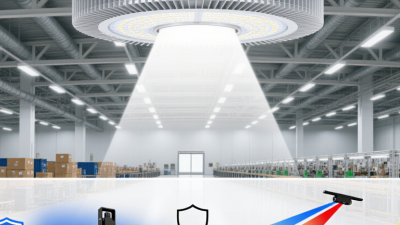
China’s industrial LED lighting market serves factory floors, warehouses, workshops, cold rooms, ports, and outdoor yards. Each setting has different demands. A high-bay fixture above a production line must deliver even light without distracting glare. A cold-storage fitting needs reliable operation at low temperatures and protection against moisture. Outdoor loading areas often require sealed housings that withstand dust, rain, and vibration.
Project planning starts with the work, not the lamp. Engineers assess mounting height, ceiling structure, task visibility, operating hours, and existing electrical systems. They may use lighting calculations, then verify results with on-site measurements after installation. High-bay and linear fixtures are common indoors; floodlights serve yards and loading zones. Dimming and occupancy controls can reduce energy use, but only when they suit shift patterns and equipment.
Specifications matter. Check measured lumen output, color consistency, glare control, thermal performance, and stated ingress protection against actual site conditions. A bright sample can flatter a product. Real performance depends on installation and maintenance too. Dust on lenses, blocked airflow, or a poor layout can weaken results. Procurement teams should request test reports and clarify warranty terms; these details are easy to overlook.
Criteria for Evaluating Chinese Industrial LED Manufacturers
Evaluating Chinese industrial LED manufacturers requires more than comparing wattage and price. The International Energy Agency’s 2019 report, Energy Efficiency 2019, estimated that lighting used about 15% of global electricity. That figure makes verified energy performance important, but a high efficacy claim alone proves little. Ask for independent test reports showing lumens per watt, color consistency, power factor, and performance at the stated operating temperature. Request results for the actual fixture, not a similar model. Details matter.
Heat and dust expose weak designs. Check housing temperature, driver quality, and ingress-protection test records for the intended factory conditions. A dusty warehouse and a washdown area need different protection. For lifetime claims, look for LM-80 LED-package data and TM-21 projections, while remembering that these do not guarantee the whole luminaire’s service life. The U.S. Department of Energy’s 2022 SSL R&D Opportunities report discusses efficacy and reliability as continuing areas of development; buyers should therefore compare measured results, not marketing promises. Ask how production batches are sampled and how failures are handled. A perfect datasheet is not enough. I would also request a pilot installation and check light levels, glare, and driver temperature after several weeks. This takes time, and the test may reveal inconvenient gaps.
China’s Industrial LED Manufacturer Evaluation Criteria
Suggested weighting for comparing manufacturers; these are evaluation weights, not company ratings or market statistics.
How to use: Assess each manufacturer against the same criteria, using verifiable documentation such as test reports, certification records, product specifications, and warranty terms. The weights add up to 100% and can be adjusted to suit project requirements.
Profiles of 10 Leading Industrial LED Manufacturers in China
China’s industrial LED sector includes manufacturers with distinct strengths, production methods, and application experience. One specializes in high-bay fixtures for warehouses, using narrow optics for tall ceilings. Another focuses on explosion-resistant enclosures, with careful sealing and thermal testing. A third produces tunnel lighting, balancing glare control with long-distance visibility. Its engineers often simulate beam distribution before assembly.
A factory serving ports develops floodlights with reinforced housings and corrosion-resistant coatings. Another supplies roadway systems, documenting photometric performance and maintenance intervals. A specialist in machine-vision lighting builds compact modules for inspection lines. Its teams test flicker and color consistency under continuous operation. One manufacturer concentrates on cold-storage lighting, selecting materials that tolerate low temperatures and repeated cleaning. Another provides modular industrial lamps, allowing damaged drivers to be replaced without removing the entire fixture.
The tenth profile belongs to a manufacturer making customized linear lights for workshops and automated facilities. It combines aluminum extrusion, controlled thermal paths, and application-specific lenses. Across these manufacturers, reliable evidence matters more than catalog brightness. Buyers should request test reports, ingress-protection records, warranty terms, and sample units. Some factories communicate technical data clearly; others still rely on vague efficiency claims. No profile is flawless. Site conditions, installation quality, and power stability can change real performance. A practical assessment should include heat, dust, vibration, wiring access, and the installer’s experience. Factory visits can reveal details that brochures rarely show.
Industrial LED Product Types and Their Key Differences
Industrial LED products differ by mounting height, beam shape, enclosure, and thermal design. High-bay fixtures suit tall factory ceilings; their focused optics direct light onto machinery and floor areas. Low-bay units fit shorter spaces, where a narrow beam can create glare. Linear fixtures spread light along assembly benches and aisles. For wet, dusty, or washdown areas, sealed vapor-tight housings help keep contaminants away from electrical components. Outdoor yards usually need floodlights with controlled, wide beams.
These distinctions affect more than appearance. A high bay installed too low may produce harsh bright spots, while a broad-beam fixture mounted high can leave work surfaces dim. Check the mounting height, required illuminance, and ambient temperature before comparing wattage. The U.S. Department of Energy’s Energy Saver guidance reports that LEDs use at least 75% less energy and can last up to 25 times longer than incandescent lighting; that comparison is a useful baseline, not a guarantee for every industrial fixture. Drivers, heat buildup, switching frequency, and dust can all affect real service life. No fixture is perfect. I would also verify photometric test files and maintenance access, since specifications alone do not show how evenly light reaches a busy production floor.
Factors to Consider When Comparing Manufacturers and Suppliers
When comparing China’s industrial LED light manufacturers, look beyond catalogue brightness and unit price. A high lumen figure means little if the fixture overheats in a dusty workshop or fails to reach the corners of a loading bay. Ask for photometric files, beam-angle options, and test reports that match the exact model under discussion. Check whether the stated lifetime comes from measured testing or a projection based on component data. Details matter.
Next, examine production consistency and support. Request sample units, then inspect housing thickness, cable entries, seals, and finish quality. Ask how the supplier tracks batches and handles defects. Clear answers are useful; vague promises are not. For projects with long operating hours, confirm replacement-part availability and realistic lead times, not just the initial delivery date. Also compare warranty terms carefully, including what labor or shipping costs are excluded.
Communication deserves a practical test. Send a drawing with mounting height, ambient temperature, and operating schedule, then see whether the proposed solution addresses each condition. A responsive technical team can help prevent glare, uneven coverage, or avoidable energy use. Still, one sample cannot represent every production run. That is easy to forget. Keep records of test results, revisions, and agreed specifications before placing a larger order.